
Workers, Days, and Work Ratio Interactive Model
Loading the math board and drawing, please wait…
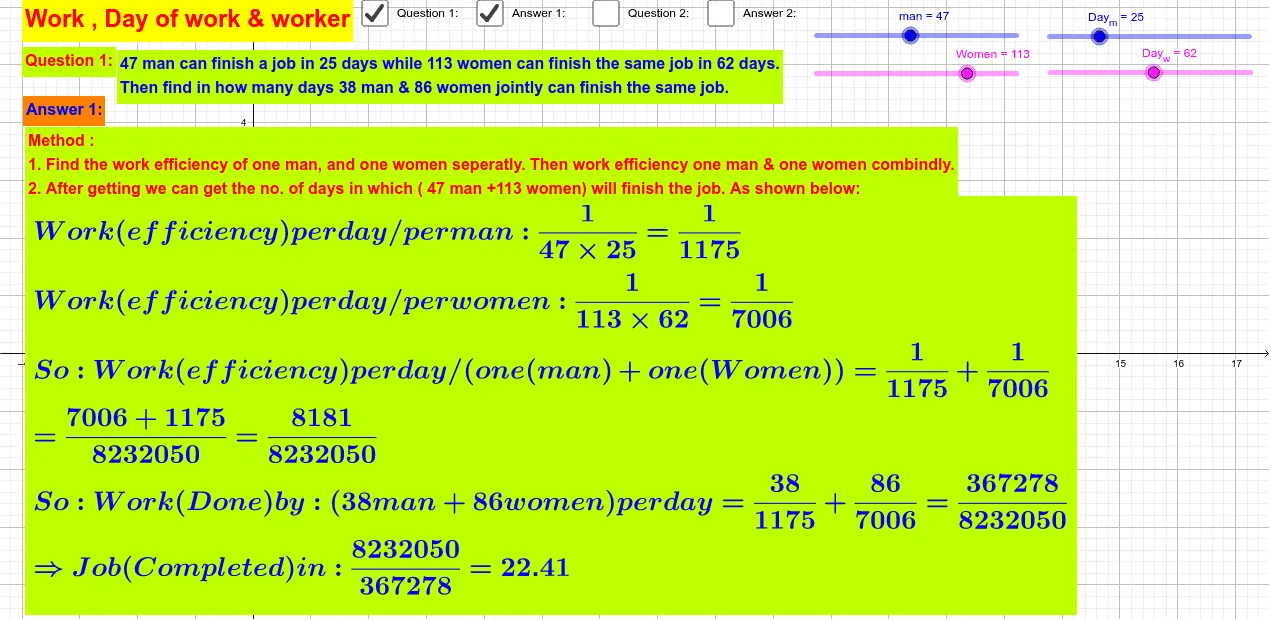
① This GeoGebra example demonstrates the proportional relationship between the number of workers (men and women) and the number of days required to complete a task, allowing users to explore how changes in workforce affect total work output. ② Core mathematical concepts include ratio and proportion, linear relationships, arithmetic operations, and basic linear programming ideas, where total work equals workers multiplied by days. ③ Construction highlights: multiple text objects (text1 to text12) provide labels and explanations; variables such as man, Women, Day_m, Day_w, a, b, c, d represent worker counts and days; objects like JPW, SMW, SWWP, RWW compute combined work rates or ratios; sliders or input fields likely enable dynamic adjustment, with results displayed as text and numeric values. ④ Suitable for middle school to high school students learning ratios, word problems, or introductory linear programming, and useful for teachers demonstrating work-allocation problems in class.
GeoGebra Commands & Parameters
Numeric man(47.0)Numeric Women(113.0)Numeric Day_m(25.0)Numeric Day_w(62.0)Numeric man_J(38.0)Numeric Women_J(86.0)Boolean a(true)Boolean b(true)Numeric Day_J(40.0)Numeric men_A(40.0)Numeric Day_A(140.0)Boolean c(false)1 / (((man_J + Women_J) * Day_J))1 / ((men_A * Day_A))JPW - SMW((JPW - SMW) * (Day_A + 30))1 / (RWW)Boolean d(false)