
Wordless Proof: Sum of Odd Numbers
Loading the math board and drawing, please wait…
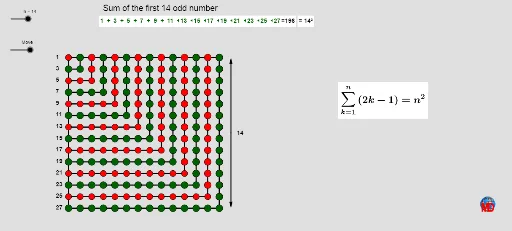
This example demonstrates visually how the sum of consecutive odd numbers forms a perfect square through dynamic geometry. Key math concepts include sequences, geometric constructions, and algebraic proofs. GeoGebra commands used are Sequence, Vector, Join, Polygon, Element, and Midpoint. Suitable for middle school students and above learning sequence summation, geometric proofs, and mathematical visualization.
GeoGebra Commands & Parameters
Sequence(Sequence[(i, j), i, 0, n - 1 - j], j, 0, n - 1) → list1Sequence(Sequence[(n + 1 - j + i, j - 1), i, 0, n - 1 - j], j, 1, n - 1) → list2Vector((-1, 1)) → uJoin(Sequence[Sequence[Translate[(n + 1 - j + i, j - 1), Vector[((k * u) * (i + 1))]], i, 0, n - 1 - j], j, 1, n - 1]) → list3Sequence(Polygon[(0, n - 1), (0, n - 1 - i), 4], i, 1, n - 1) → listPolySequence(Sequence[(i, j), i, 0, n - 1 - j], j, 0, n - 1, 2) → l1Sequence(Sequence[Translate[(n + 1 - j + i, j - 1), Vector[((k * u) * (i + 1))]], i, 0, n - 1 - j], j, 1, n - 1, 2) → l3Sequence(Segment[(0, i), ((2 * n) - 2 - (2 * i), i)], i, 0, n - 2) → listSegmentSequence(Segment[(0, i), ((2 * n) - (n + 1) - i, i)], i, 0, n - 2) → l2Sequence(((2 * n) - (n + 1) - i, i), i, 0, n - 2) → l5Join(Sequence[Sequence[Translate[(n + 1 - j + i, j - 1), Vector[((k * u) * (i + 1))]], i, 0, n - 1 - j], j, 1, n - 1, 1]) → l4Vector(Element[l5, 1], Element[list3, 1]) → vSequence(Translate[Element[l5, i], Vector[((n - i) * v)]], i, 1, Length[l5]) → l6Sequence(Segment[Element[l5, i], Element[l6, i]], i, 1, Length[l5]) → l7Polygon((0, n - 1), (0, 0), 4) → poly1Sequence(Text[(2 * k) + 1, (-1.1, n - k - 1.1)], k, 0, n - 1) → l8Sequence(Text[(2 * k) + 1 + "+"], k, 0, n - 1) → l9Sequence(A + ((1.15 * i), 0), i, 0, n) → l10Sequence(Text[Element[l8, k] + " + ", Element[l10, k]], k, 1, n) → l11Element(l5, 1) → MMElement(l6, 1) → NNMidpoint(B, C) → DVector(D, B) → wVector(D, C) → a