
Which quadrilaterals are parallelograms?
Loading the math board and drawing, please wait…
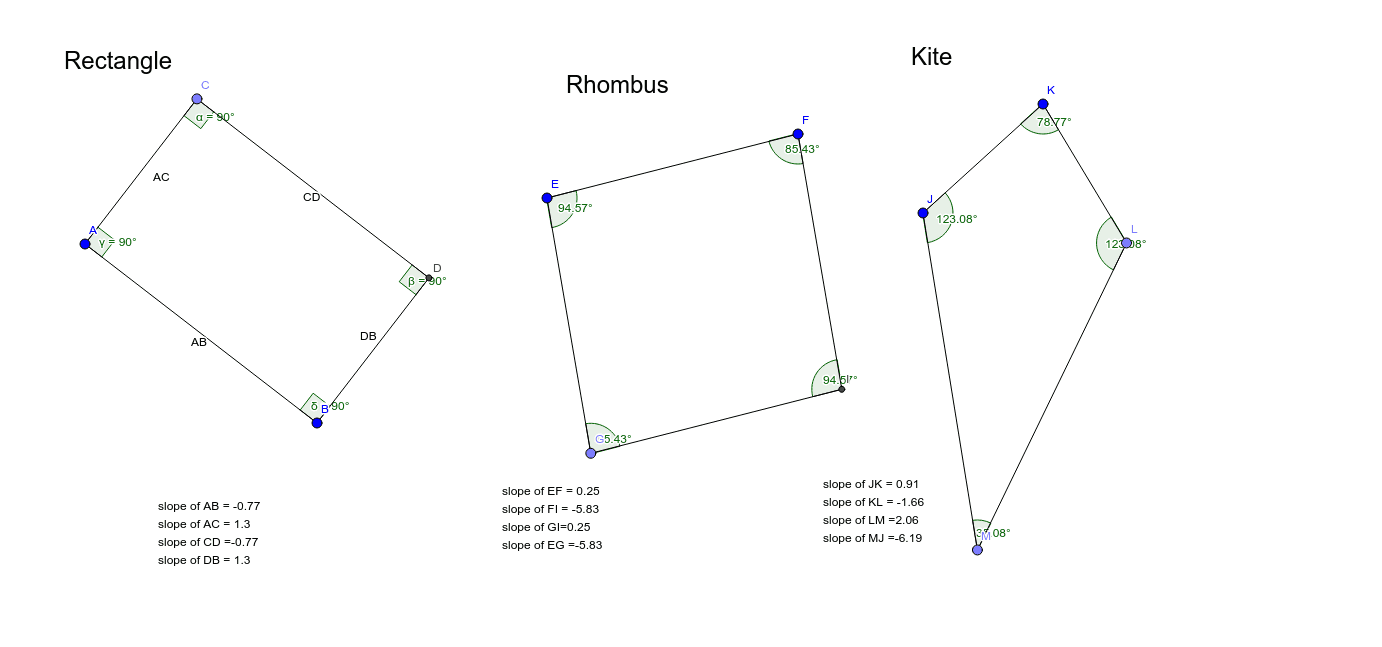
This example demonstrates how students discover that rectangles and rhombuses are always parallelograms. It involves core math concepts like parallelograms, quadrilateral classification, and geometric properties. Construction highlights include using commands/objects such as Segment, OrthogonalLine, Point, Intersect, Angle, Slope, and Circle in GeoGebra. Suitable for middle school and above students for geometry learning and exploration.
GeoGebra Commands & Parameters
Segment(A, B) → ABOrthogonalLine(B, AB) → bOrthogonalLine(A, AB) → cPoint(c) → COrthogonalLine(C, b) → dIntersect(d, b) → DSegment(A, C) → ACSegment(C, D) → CDSegment(D, B) → DBAngle(A, C, D) → αAngle(C, D, B) → βAngle(B, A, C) → γAngle(D, B, A) → δSlope(AB) → aSlope(AC) → eSlope(CD) → fSlope(DB) → gSegment(E, F) → hCircle(E, F) → kCircle(F, E) → pPoint(k) → GSegment(E, G) → iCircle(G, E) → qIntersect(p, q) → H, I, ,Segment(G, I) → jSegment(I, F) → lSlope(h) → mSlope(i) → nSlope(j) → oSlope(l) → rSegment(J, K) → sCircle(K, J) → tPoint(t) → LSegment(K, L) → a_1Segment(J, L) → b_1OrthogonalLine(K, b_1) → c_1Point(c_1) → MSegment(J, M) → d_1Segment(L, M) → e_1Slope(s) → uSlope(a_1) → vSlope(e_1) → wSlope(d_1) → f_1Angle(E, F, I) → εAngle(F, I, G) → ζAngle(G, E, F) → ηAngle(I, G, E) → θAngle(J, K, L) → ιAngle(K, L, M) → κAngle(L, M, J) → λAngle(M, J, K) → μ
AI Drawing Prompt Reference
Draw a quadrilateral ABCD where AB is parallel to CD and AD is parallel to BC. Start by drawing segment AB through points A and B, then draw the perpendicular line b through point B to AB, and the perpendicular line c through point A to AB. The intersection of c and b is point C. Next, draw the perpendicular line d through point C to line b, and the intersection of d and b is point D. Ensure that AB is parallel to CD and AD is parallel to BC.
The prompt above was compiled from the original drawing commands and is for reference only.