
What Kind of Quadrilateral? Midpoints, Circles, and Intersections
Loading the math board and drawing, please wait…
In collections
Congruence (CO) Cluster
Congruence (Vol 2)
CCSS High School: Geometry (Congruence) Volume 2
CCSS High School: Geometry (Congruence) Volume 2
CCSS High School: Geometry (Congruence) Volume 2
Geometry (Congruence) Volume 2
CCSS High School: Geometry (Congruence) Volume 2
CCSS High School: Geometry (Congruence) Volume 2
CCSS High School: Geometry (Congruence) Volume 2
CCSS High School: Geometry (Congruence) Volume 2
CCSS High School: Geometry (Congruence) Volume 2
CCSS High School: Geometry (Congruence) Volume 2
CCSS High School: Geometry (Congruence) Volume 2
Gail LeBlancCCSS High School: Geometry (Congruence) Volume 2
CCSS High School: Geometry (Congruence) Volume 2
Quadrilaterals
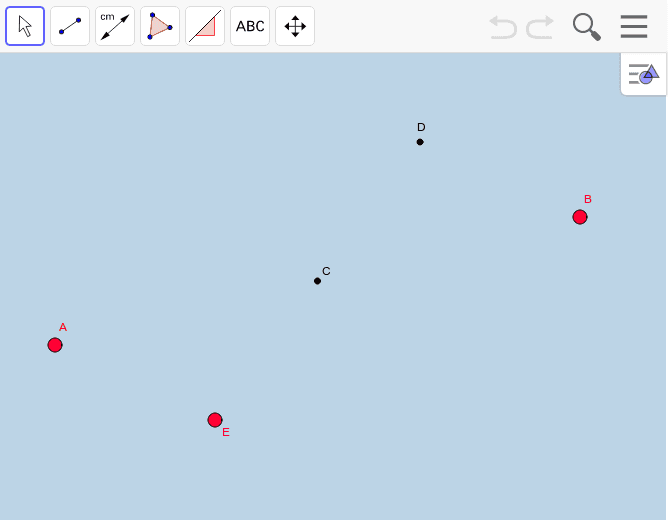
This interactive GeoGebra example helps students determine what kind of quadrilateral is shown by examining side relationships, diagonals, midpoints, and auxiliary circles. It focuses on quadrilateral classification, parallelogram properties, perpendicularity, and geometric construction reasoning. The construction uses Midpoint to create midpoint objects, Segment to connect vertices or diagonals, Circle to draw auxiliary circles, Line to extend geometric relationships, and Intersect to locate key intersection points, with objects such as A, B, C, D, and E labeling vertices and intersections. It is suitable for middle-school and high-school geometry lessons, inquiry activities, and practice tasks that develop dynamic visualization and proof-oriented thinking.
GeoGebra Commands & Parameters
Midpoint(A, B) → CSegment(A, C) → aSegment(C, B) → bCircle(C, E) → cLine(E, C) → dIntersect(c, d, 2) → D
AI Drawing Prompt Reference
Start by drawing two points as endpoints of a segment, then find the midpoint of that segment and connect it to both endpoints with line segments. Next, draw a circle centered at this midpoint with a radius determined by another given point. Then draw a line passing through the midpoint and that given point, and mark the second intersection point where this line meets the circle. The final figure shows a segment divided into two equal parts, a circle, a line, and an intersection point, useful for exploring quadrilateral properties.
The prompt above was compiled from the original drawing commands and is for reference only.