
Week 6 Calculus: Geometry and Function Fitting
Loading the math board and drawing, please wait…
In collections
Length, Area, & Volume MAT 6715 by Laura Anderson
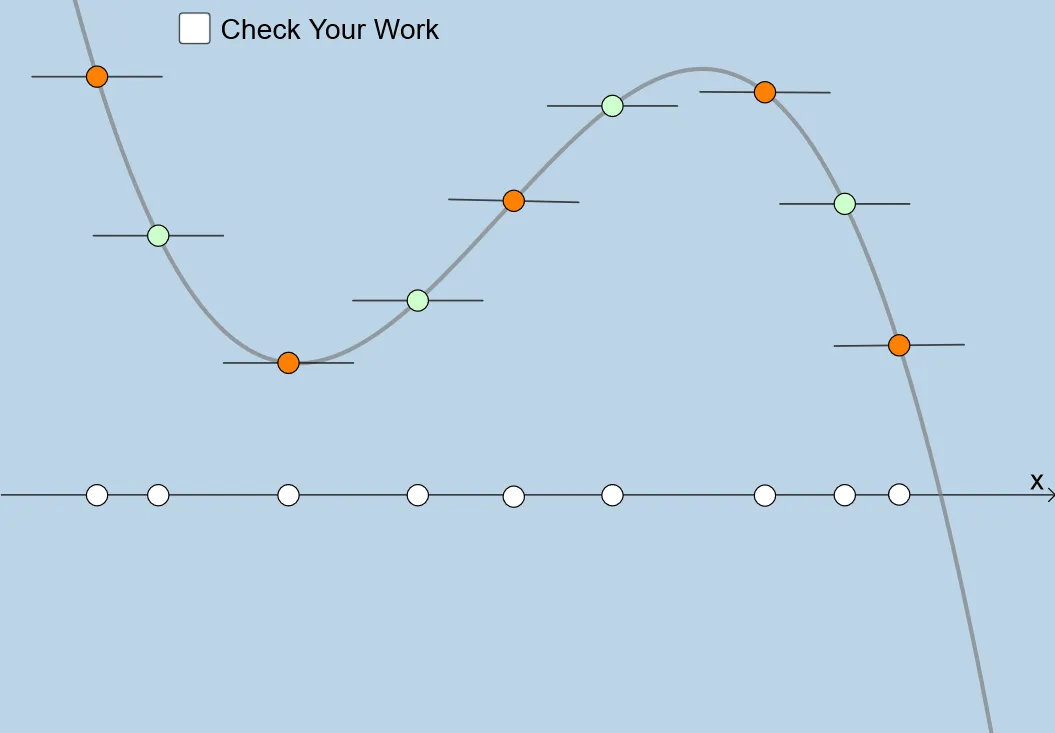
This example demonstrates a comprehensive mathematical construction combining geometric figures with calculus concepts, using points, circles, polygons, and polynomial fitting to show dynamic relationships between functions and geometric objects. Core concepts include derivatives (object f' represents the derivative function), function fitting via FitPoly, and geometry with circles, segments, and intersections, also touching on sequences and combinatorics. Construction uses FitPoly, Point, Circle, Intersect, and Segment commands, with objects A through S, functions f and f', auxiliary lines k-t, circles c, d, e, etc., forming a complex multi-object system. Suitable for pre-university or early undergraduate calculus courses as a comprehensive exercise or demonstration, helping students understand connections between functions, derivatives, and geometric figures, and useful for classroom presentations.
GeoGebra Commands & Parameters
FitPoly({A, B, C, D}, 3) → fPoint(g) → EPoint(h) → FPoint(i) → GPoint(j) → HCircle(A, 1) → cCircle(B, 1) → dCircle(C, 1) → eCircle(D, 1) → pIntersect(c, k, 1) → IIntersect(c, k, 2) → JIntersect(d, l) → K, LIntersect(e, m) → M, NIntersect(p, n) → O, PSegment(I, J) → qSegment(K, L) → rSegment(M, N) → sSegment(O, P) → tPoint(f) → QPoint(a) → RCircle(Q, 1) → c_1Intersect(c_1, b) → S, TSegment(S, T) → f_1Point(f) → VPoint(f) → WPoint(f) → ZPoint(f) → A_1Point(g_1) → B_1Point(h_1) → C_1Point(i_1) → D_1Point(j_1) → E_1Circle(V, 1) → d_1Circle(W, 1) → e_1Circle(Z, 1) → p_1Circle(A_1, 1) → q_1Intersect(p_1, m_1) → F_1, G_1Intersect(q_1, n_1) → H_1, I_1Intersect(e_1, l_1) → J_1, K_1Intersect(d_1, k_1) → L_1, M_1Segment(L_1, M_1) → r_1Segment(J_1, K_1) → s_1Segment(F_1, G_1) → t_1Segment(H_1, I_1) → a_1
AI Drawing Prompt Reference
Draw a graph with a polynomial fitting function f and four unit circles c, d, e, p around points A, B, C, and D. Use the intersection points I, J, K, L, M, N, O, P and auxiliary lines k, l, m, n to construct several segments q, r, s, t. Then, with the derivative function f', points E, F, G, H, I, J, K, L, M, N, O, P, Q, R, S, T, V, W, Z, A1, B1, C1, D1, and E1, further construct new circles and segments to form a complex geometric figure.
The prompt above was compiled from the original drawing commands and is for reference only.