
Water in the Glass: Rotation and Volume
Loading the math board and drawing, please wait…
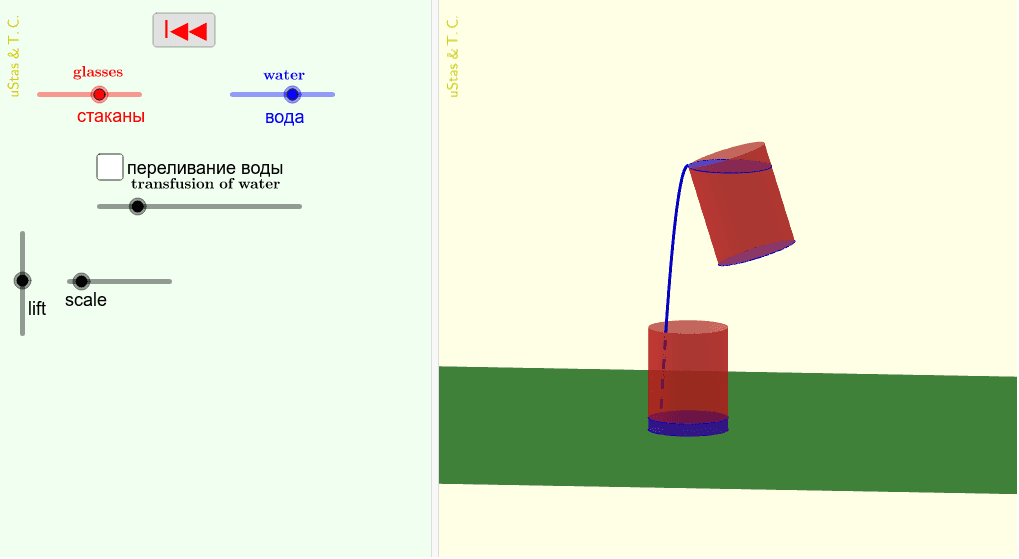
This example illustrates the rotation and volume changes of water in a glass. Key mathematical concepts include the calculation of the volume of a solid of revolution in solid geometry. Using commands such as rotation, intersect path, circle, and line, it demonstrates the volume changes of water at different rotation angles. Suitable for high school mathematics education, particularly in solid geometry and calculus.
GeoGebra Commands & Parameters
RotateText("uStas\;\&\,Т.С.", 90°) → надпись01Rotate(Circle[Q, m, zAxis], γ, Line[A, yAxis]) → ωCylinder(ω, (k * m)) → Ω, ω', aIntersectPath(ζ, Ω) → φCircle(O_1, m, zAxis) → ω_1Cylinder(ω_1, (k * m)) → Ω_1, ω'_1, a_1Line(A + (0, 0, (0.5 * p)), xAxis) → dParabola(F, d) → cIf(h_1 > (k * m), acos(q - 1)) → βIf(h_1 ≤ (k * m), (m * t), (((0.5 * k) * m) * (π + β + ((1 - q) * sqrt((q * (2 - q))))) / π)) → h_2Cylinder(ω_1, h_2) → Ω_2, ω'_2, a_2Intersect(Line[O_1 + (0, 0, h_2), xAxis], c, 1) → CCurveCartesian(x(A) + j, 0, z(A) - (0.5 * j^(2) / p), j, 0, jj) → θIntersect(ζ, ω) → U_1, U_2Arc(ω, U_2, U_1) → ωωArc(φ, U_2, U_1) → φ'