
Volume of the Parallelepiped Formed by Vectors a, b & c
Loading the math board and drawing, please wait…
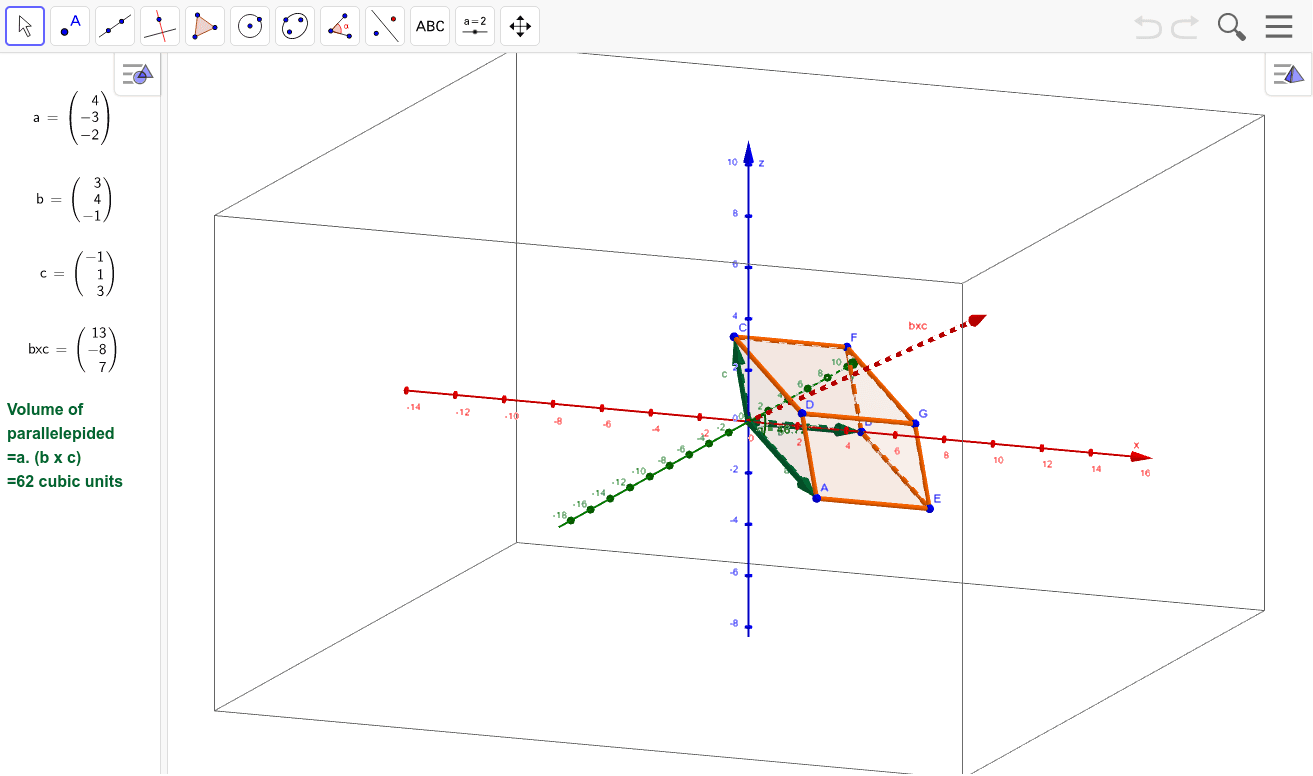
① This GeoGebra example dynamically demonstrates a parallelepiped spanned by three spatial vectors a, b, and c, and visually shows that its volume equals the absolute value of the scalar triple product (a × b) · c. ② Core mathematical concepts include vector cross product, dot product, scalar triple product, volume formula of a parallelepiped, and the geometric interpretation of vector operations. ③ Construction highlights: the Vector command creates vectors a, b, c; Segment and Polygon build the edges and faces of the parallelepiped; PointIn and Angle mark key points and angles; LaTeX displays the volume formula. Objects include vectors a, b, c, vertices A, B, C, D, E, F, G, the cross product vector bxc, multiple polygons poly1–poly4, and auxiliary segments. ④ Suitable for senior high school or university courses in linear algebra and analytic geometry, useful for teaching vector operations and spatial volume, and as an interactive tool for classroom demonstration or student exploration.
GeoGebra Commands & Parameters
Vector((4, -3, -2)) → aVector((3, 4, -1)) → bVector((-1, 1, 3)) → cSegment(A, D) → dSegment(D, C) → eSegment(A, E) → fSegment(B, E) → gSegment(C, F) → hSegment(B, F) → iSegment(E, G) → jSegment(G, F) → kSegment(D, G) → lPolygon((0, 0), A, E, B) → poly1, m, a_1, e_1, b_1Polygon((0, 0), A, D, C) → poly2, n, a_2, d_1, c_1Polygon(A, E, G, D) → poly3, p, q, r, sPointIn(poly3) → Pointpoly3Polygon(C, D, G, F) → poly4, c_2, d_2, g_1, f_1Polygon((0, 0), C, F, B) → poly5, t, c_3, f_2, b_2Angle(a, bxc) → αLaTeX(a, true, true) → text1LaTeX(b, true, true) → text2LaTeX(c, true, true) → text3LaTeX(bxc, true, true) → text4