
Volume of Revolution Disks
Loading the math board and drawing, please wait…
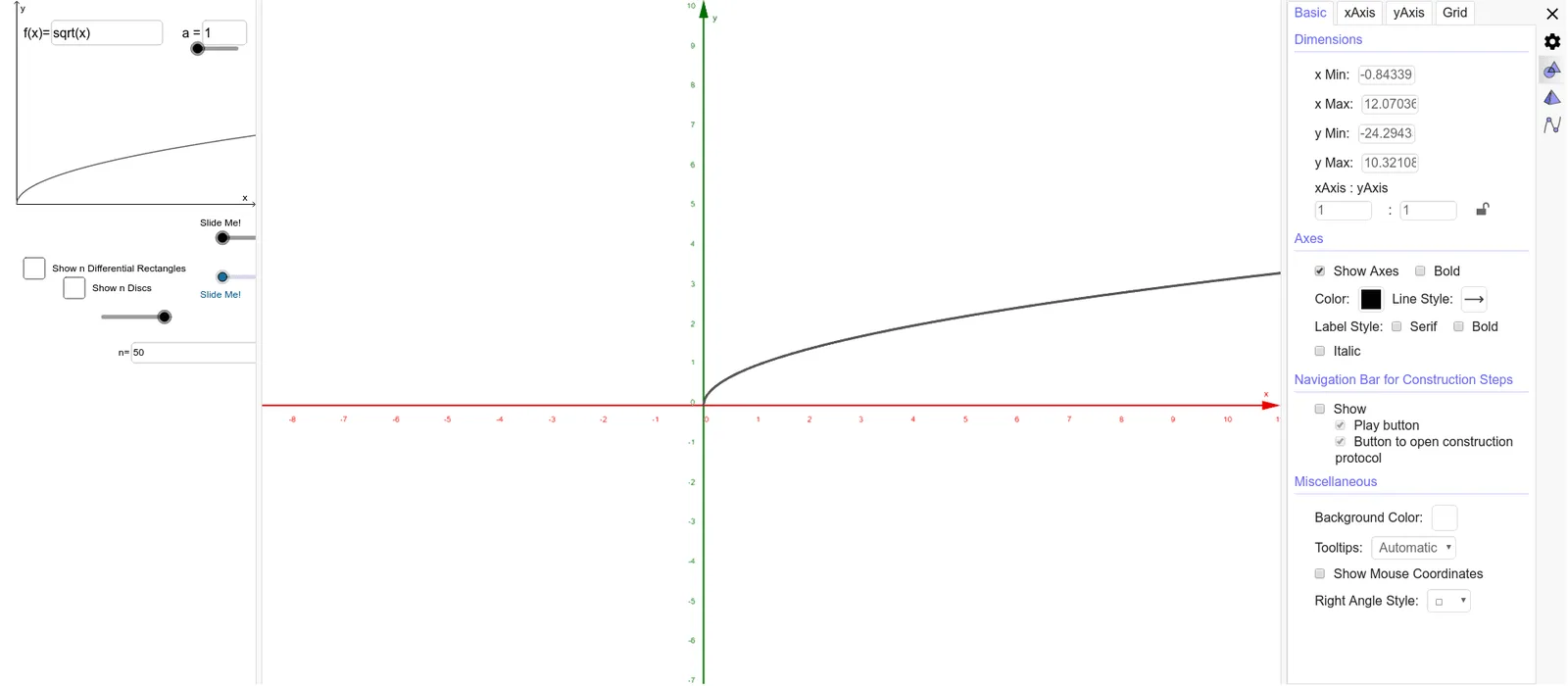
This example demonstrates the calculation of the volume of a solid of revolution using the disk method. It involves core mathematical concepts such as integration, function graphing, rotational transformations, and volume computation. GeoGebra commands and objects like Sequence, Rotate, Circle, Surface, Textfield, and Integral are used in the construction. Suitable for high school and above students to understand the application of calculus in geometry.
GeoGebra Commands & Parameters
Sequence(Polygon[(a + (i * deltax), 0), (a + ((i + 1) * deltax), 0), (a + ((i + 1) * deltax), f(a + ((i + 1) * deltax))), (a + (i * deltax), f(a + ((i + 1) * deltax)))], i, 0, n - 1, 1) → list1Rotate(list1, α, y = 0) → list1'Sequence((a + (i * deltax), 0), i, 0, n, 1) → list2Sequence((a + (i * deltax), f(a + (i * deltax))), i, 1, n, 1) → list3Rotate(list3, α, y = 0) → list3'Sequence((a + (i * deltax), f(a + ((i + 1) * deltax))), i, 0, n - 1, 1) → list4Sequence(x = a + (i * deltax), i, 1, n, 1) → list6Sequence(Segment[Element[list3, i], Element[list4, i]], i, 0, n, 1) → list5Sequence(CircleSector[Element[list2, i + 1], Element[list3', i], Element[list3, i], xOyPlane], i, 1, n, 1) → list7Sequence(Cylinder[Element[list2, i], Element[list2, i + 1], f(Element[list2, i + 1])], i, 1, n, 1) → list8Sequence(Circle[Element[list2, i], f(Element[list2, i]), x = 0], i, 2, n + 1, 1) → list10Circle((a, 0), f(a + deltax), x = 0) → pSurface(q, α, xAxis) → eTextfield(f) → InputBox1Textfield(a) → InputBox2Textfield(b) → InputBox3Integral(f, a, b) → m_1Textfield(n) → InputBox4
AI Drawing Prompt Reference
Draw the volume of a solid of revolution using the disk method. First, plot the function f(x) in the interval [a, b], then rotate it around the x-axis to form a series of disks. Calculate the volume of each disk and sum them up to get the total volume of the solid. Use input fields to enter the function f(x), interval endpoints a and b, and the number of divisions n. Based on this information, generate a sequence of disks and rotate them, finally displaying the total volume.
The prompt above was compiled from the original drawing commands and is for reference only.