
Volume of a Triangular Prism - Interactive 3D Demo
Loading the math board and drawing, please wait…
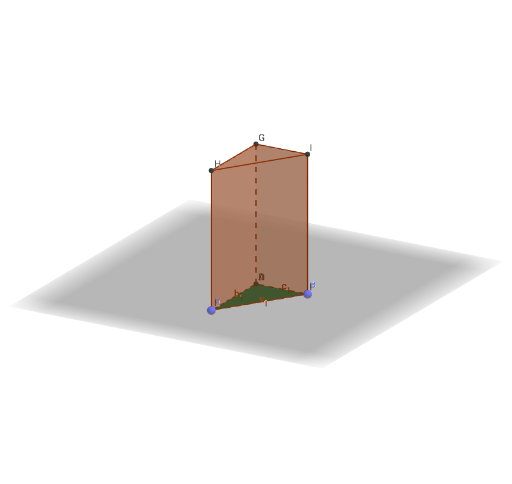
① This GeoGebra example demonstrates the construction of a triangular prism in 3D space and visually illustrates how its volume depends on the base area and height. ② Core mathematical concepts include the volume formula V = base area × height for prisms, triangular geometry, polygons, solid geometry, and spatial reasoning. ③ Construction highlights: from the summary, commands such as Intersect, Point, Polygon, and Prism are used to create base triangle ABC, top vertices D/E/F, lateral faces (faceACED, faceBCEF, faceABFD), edges (edgeAD, edgeCE, edgeBF, etc.), and auxiliary polygons, forming a complete prism model. ④ Suitable for middle school geometry (introduction to 3D shapes) and high school solid geometry, as well as college-level demonstrations of volume formulas; it helps learners intuitively connect the prism's volume to its base area and height.
GeoGebra Commands & Parameters
Intersect(xAxis, yAxis) → APoint(xAxis) → BPoint(yAxis) → CPolygon(A, C, B) → poly1, b, a, cPrism(poly1, h) → d, D, edgeBF, edgeDE, edgeEF, edgeDF, E, F, faceACED, faceBCEF, faceABFD, faceDEF, edgeAD, edgeCEPolygon(A, C, B) → poly2, b_1, a_1, c_1Prism(poly1, 5) → e, G, edgeBI, edgeGH, edgeHI, edgeGI, H, I, faceACHG, faceBCHI, faceABIG, faceGHI, edgeAG, edgeCH
AI Drawing Prompt Reference
Draw a 3D triangular prism with a right-triangle base lying in the coordinate plane, its three vertices on the two axes. The prism height is adjustable via a slider, and a second identical-base prism is shown for volume comparison. Include six vertices, three rectangular lateral faces, two triangular bases, and vertical edges connecting corresponding vertices. Clearly display the prism's solid structure and illustrate how volume depends on base area and height.
The prompt above was compiled from the original drawing commands and is for reference only.