
Volume of a Rectangular Pyramid: Dynamic Construction
Loading the math board and drawing, please wait…
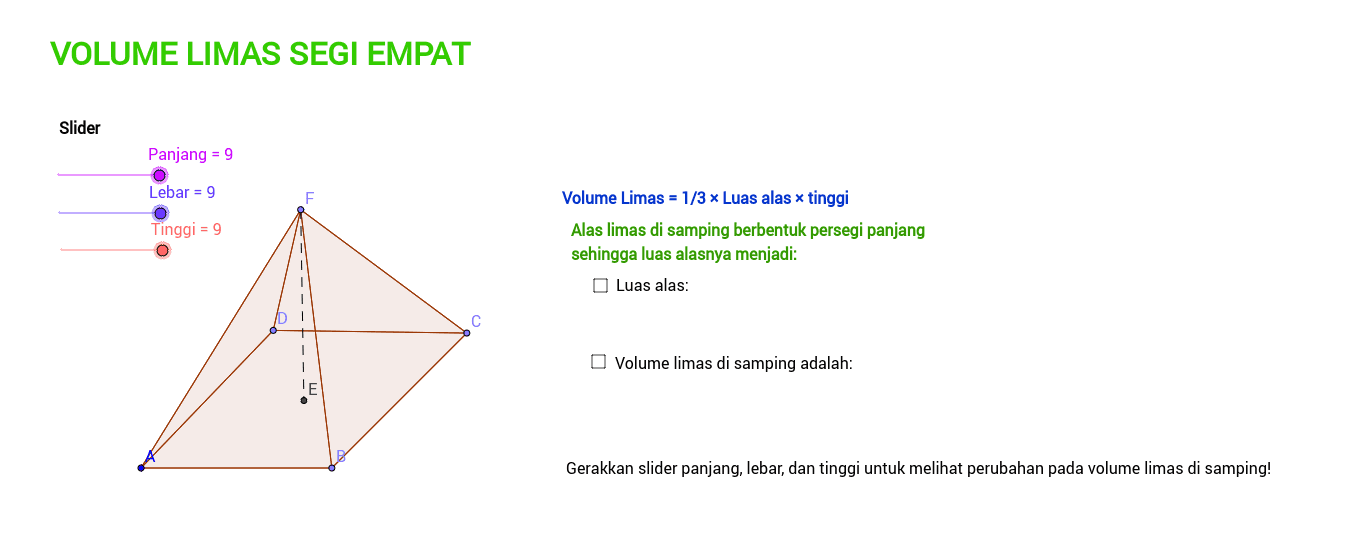
This GeoGebra example demonstrates the volume and geometric construction of a rectangular pyramid (limas segi empat). By dynamically adjusting the base length (Panjang), width (Lebar), and height (Tinggi), users can visually explore how the pyramid volume changes with base area and height. Core mathematical concepts include solid geometry, the pyramid volume formula, polygon area computation, and spatial relationships among points, lines, and planes in 3D space. The construction uses GeoGebra commands Point to define vertices A–F, Midpoint to construct midpoints, Polygon to generate the base and lateral faces poly1 through poly5, and Segment to draw edges such as a, b, c, d, supplemented by text objects like LuasAlas for labeling base area and volume. Suitable for middle and high school mathematics instruction, classroom demonstrations, and independent inquiry into the geometric meaning of volume formulas.
GeoGebra Commands & Parameters
Point(Circle[A, Lebar]) → BPoint(Circle[B, Panjang]) → CPoint(Circle[A, Panjang]) → DMidpoint(Segment[A, C]) → EPoint(Circle[E, Tinggi]) → FPolygon(A, B, C, D) → poly1, a, b, c, dPolygon(F, D, C) → poly2, c_1, f, d_1Polygon(F, A, D) → poly3, d_2, f_1, a_1Polygon(F, B, A) → poly4, a_2, f_2, b_1Polygon(F, C, B) → poly5, b_2, f_3, c_2Segment(F, E) → e