
Volume of a Parallelepiped
Loading the math board and drawing, please wait…
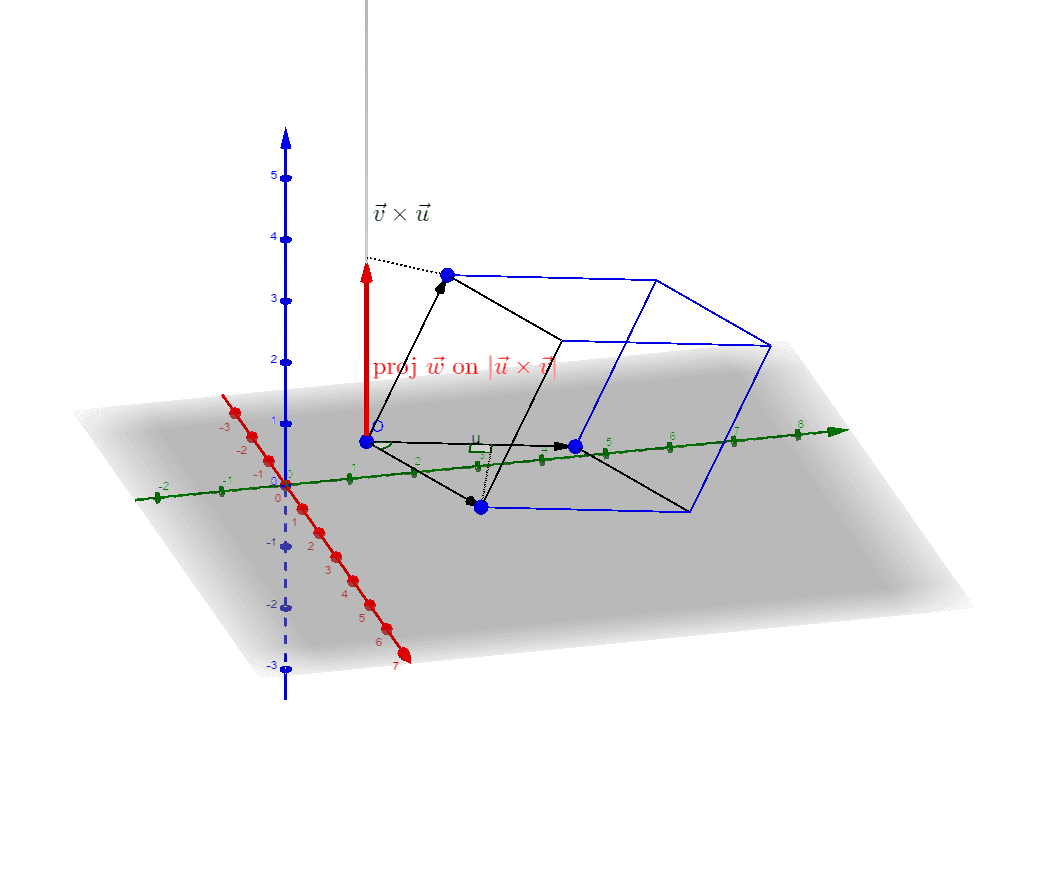
This example demonstrates how to calculate the volume of a parallelepiped using geometric construction. Key mathematical concepts include vectors, solid geometry, and coordinate geometry. Using GeoGebra commands such as Vector, Point, Segment, and Intersect, the construction process of a parallelepiped is visually illustrated. Suitable for high school mathematics education and students learning solid geometry.
GeoGebra Commands & Parameters
Vector(O, B) → uVector(O, A) → vVector(O, C) → wSegment(A, D) → fSegment(B, D) → gSegment(D, E) → hSegment(C, F) → iSegment(C, G) → jSegment(G, E) → kSegment(B, G) → lSegment(F, A) → mSegment(F, E) → nAngle(B, O, A) → αVector(O, O + v ⊗ u) → aSegment(O, H) → pOrthogonalLine(C, p, space) → qPoint(q) → IVector(O, I) → bSegment(C, I) → rMidpoint(O, I) → JMidpoint(O, H) → KSegment(O, B) → sOrthogonalLine(A, s, space) → tIntersect(s, t) → LSegment(A, L) → cAngle(O, L, A) → β