
Volume Model with Unit Cubes
Loading the math board and drawing, please wait…
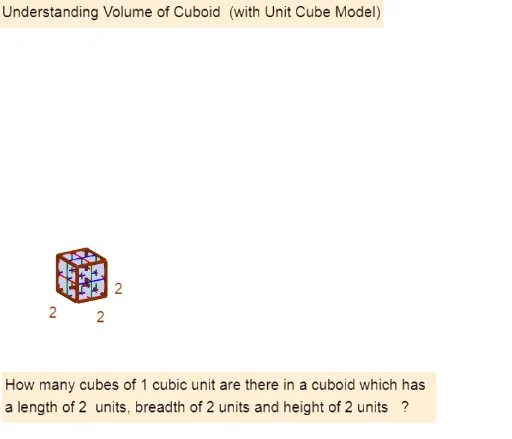
This example demonstrates how to build a volume model using unit cubes, visually illustrating the volume calculation of cubes and cuboids. Core math concepts include volume, cube, cuboid, statistical characteristics, boxplot, algebra, Poisson distribution, and variance. It utilizes GeoGebra commands like Sequence, Polygon, Prism, and objects such as length, breadth, height. Suitable for high school students learning solid geometry and volume calculations, or probability statistics teaching.
GeoGebra Commands & Parameters
Sequence(Sequence[Segment[(0, b, h), (length, b, h)], b, 0, breadth], h, 0, height) → listLsegmSequence(Sequence[Segment[(l, b, 0), (l, b, height)], l, 0, length], b, 0, breadth) → listHsegmSequence(Sequence[Segment[(l, 0, h), (l, breadth, h)], l, 0, length], h, 0, height) → listBsegmPolygon((0, 0), (length, 0), (length, breadth), (0, breadth)) → poly1, f, g, h, iPrism(poly1, height) → a, A, edge1, edge2, edge3, edge4, edgeAB, edgeBC, edgeCD, edgeAD, B, C, D, face1, face3, face4, face2, faceABCD