
Volume Model Using Unit Cubes
Loading the math board and drawing, please wait…
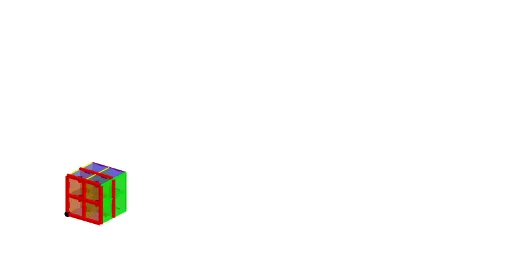
① This example demonstrates how to build a rectangular prism by stacking unit cubes, allowing users to dynamically adjust the number of cubes along length, width, and height to observe the total volume change. ② The core mathematical concept is the definition and calculation of volume: the volume of a cuboid equals the product of the counts of unit cubes along three dimensions, reinforcing multiplication and spatial counting. ③ Construction highlights: using GeoGebra commands SelectedIndex and Sequence to generate a 3D grid, with objects nx, ny, nz controlling cube counts in each direction, and variables l_x, s_x, etc., defining cube positions and sizes; lists L_s1, L_b, L_t, etc., assemble the full cuboid, while slider sp and text1 display the volume value. ④ Suitable for upper elementary to middle school students learning volume concepts, and for geometry teaching to visually bridge 1D length and 3D volume understanding.
GeoGebra Commands & Parameters
SelectedIndex(nx) → l_xSelectedIndex(ny) → l_ySelectedIndex(nz) → l_zSequence(Sequence[Sequence[Polygon[(x(A) + i - 1, y(A) + j - 1, z(A) + k - 1), (x(A) + i, y(A) + j - 1, z(A) + k - 1), (x(A) + i, y(A) + j - 1, z(A) + k), (x(A) + i - 1, y(A) + j - 1, z(A) + k)], i, 1, (l_x * (1 + s_x)), 1 + s_x], j, 1, (l_y * (1 + s_y)), 1 + s_y], k, 1, (l_z * (1 + s_z)), 1 + s_z) → L_{s1}Sequence(Sequence[Sequence[Polygon[(x(A) + i - 1, y(A) + j - 1, z(A) + k - 1), (x(A) + i, y(A) + j - 1, z(A) + k - 1), (x(A) + i, y(A) + j, z(A) + k - 1), (x(A) + i - 1, y(A) + j, z(A) + k - 1)], i, 1, (l_x * (1 + s_x)), 1 + s_x], j, 1, (l_y * (1 + s_y)), 1 + s_y], k, 1, (l_z * (1 + s_z)), 1 + s_z) → L_{b}Sequence(Sequence[Sequence[Polygon[(x(A) + i - 1, y(A) + j - 1, z(A) + k), (x(A) + i, y(A) + j - 1, z(A) + k), (x(A) + i, y(A) + j, z(A) + k), (x(A) + i - 1, y(A) + j, z(A) + k)], i, 1, (l_x * (1 + s_x)), 1 + s_x], j, 1, (l_y * (1 + s_y)), 1 + s_y], k, 1, (l_z * (1 + s_z)), 1 + s_z) → L_{t}Sequence(Sequence[Sequence[Polygon[(x(A) + i - 1, y(A) + j, z(A) + k - 1), (x(A) + i, y(A) + j, z(A) + k - 1), (x(A) + i, y(A) + j, z(A) + k), (x(A) + i - 1, y(A) + j, z(A) + k)], i, 1, (l_x * (1 + s_x)), 1 + s_x], j, 1, (l_y * (1 + s_y)), 1 + s_y], k, 1, (l_z * (1 + s_z)), 1 + s_z) → L_{s3}Sequence(Sequence[Sequence[Polygon[(x(A) + i, y(A) + j - 1, z(A) + k - 1), (x(A) + i, y(A) + j, z(A) + k - 1), (x(A) + i, y(A) + j, z(A) + k), (x(A) + i, y(A) + j - 1, z(A) + k)], i, 1, (l_x * (1 + s_x)), 1 + s_x], j, 1, (l_y * (1 + s_y)), 1 + s_y], k, 1, (l_z * (1 + s_z)), 1 + s_z) → L_{s2}Sequence(Sequence[Sequence[Polygon[(x(A) + i - 1, y(A) + j - 1, z(A) + k - 1), (x(A) + i - 1, y(A) + j, z(A) + k - 1), (x(A) + i - 1, y(A) + j, z(A) + k), (x(A) + i - 1, y(A) + j - 1, z(A) + k)], i, 1, (l_x * (1 + s_x)), 1 + s_x], j, 1, (l_y * (1 + s_y)), 1 + s_y], k, 1, (l_z * (1 + s_z)), 1 + s_z) → L_{s4}