
Volume Investigation
Loading the math board and drawing, please wait…
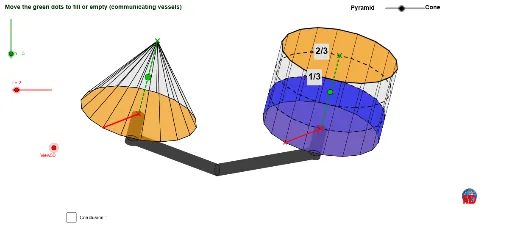
This example demonstrates the exploration of volume through 3D geometry and vector calculations. It involves core mathematical concepts such as volume computation, trigonometry, equation solving, 2D vector operations, and set theory. Key GeoGebra commands and objects used include Vector, Sequence, Segment, Translate, Line, Intersect, Polygon, Point, Midpoint, If, and Element, which are essential for constructing the geometric models and animations. Suitable for high school students and educators, this tool aids in deepening understanding of solid geometry and vector mathematics.
GeoGebra Commands & Parameters
Vector(CC, Z) → wVector(CC, Y) → vVector(CC, X) → uSequence(O + ((r * cos(i)) * u) + ((r * sin(i)) * v) - (h / 2 * w), i, 0, 6.28319, (2 * π / n)) → liste1Segment(F, E) → jSegment(G, E) → iTranslate(G, Vector[((3 * d) * Vector[G, F])]) → F'Line(F', j) → kIntersect(k, i) → ITranslate(D, Vector[((3 * d) * Vector[D, K])]) → E'Segment(I, F') → lSequence(A + ((r * cos(i)) * u) + ((r * sin(i)) * v), i, 0, 6.28319, (2 * π / n)) → liste2Sequence(Polygon[Element[liste1, i], Element[liste1, i + 1], Element[liste2, i + 1], Element[liste2, i]], i, 1, Length[liste1]) → liste3Sequence(B + ((r * cos(i)) * u) + ((r * sin(i)) * v) - (h / 2 * w), i, 0, 6.28319, (2 * π / n)) → liste4Sequence(Polygon[Element[liste4, i], Element[liste4, i + 1], D], i, 1, Length[liste1]) → liste5Polygon(liste1) → poly1Translate(liste1, Vector[(d * Vector[J, A])]) → liste7Segment(D, B) → cSequence(E' + ((l * cos(i)) * u) + ((l * sin(i)) * v), i, 0, 6.28319, (2 * π / n)) → liste9Sequence(Polygon[Element[liste1, i], Element[liste1, i + 1], Element[liste7, i + 1], Element[liste7, i]], i, 1, Length[liste1]) → liste8Segment(F, G) → gPolygon(liste4) → poly2Polygon(liste2) → poly3Sequence(Segment[Element[liste1, i], Element[liste1, i + 1]], i, 1, Length[liste1]) → liste11Point(liste1) → HSegment(A, J) → aSegment(D, K) → mSequence(Segment[Element[liste4, i], Element[liste4, i + 1]], i, 1, Length[liste4]) → liste12Polygon(liste7) → poly4Vector(J, K) → zTranslate(H, z) → H'Segment(K, H') → sSegment(J, H) → qSequence(Polygon[Element[liste4, i], Element[liste4, i + 1], Element[liste9, i + 1], Element[liste9, i]], i, 1, Length[liste1]) → liste10Vector(P, K) → pVector(N, J) → tSequence(P + ((r / 10 * cos(i)) * u) + ((r / 10 * sin(i)) * v), i, 0, 6.28319, 0.15707963267948966) → liste13Polygon(liste13) → poly5Sequence(N + ((r / 10 * cos(i)) * u) + ((r / 10 * sin(i)) * v), i, 0, 6.28319, 0.15708) → liste14Polygon(liste14) → poly6Midpoint(P, N) → LSequence(S + ((r / 10 * cos(i)) * u) + ((r / 10 * sin(i)) * w), i, 0, 6.28319, 0.15708) → liste17Polygon(liste17) → poly7Vector(S, P) → u_1Vector(S, N) → v_1Sequence(Translate[poly7, Vector[(i * u_1)]], i, 0, 1, 0.01) → liste18Sequence(Translate[poly7, Vector[(i * v_1)]], i, 0, 1, 0.01) → liste19If(y(B) > y(O), 1, -1) → aaSequence(Translate[poly1, Vector[(i * Vector[J, A])]], i, 0.3333333333333333, 0.6666666666666666, 0.33333) → liste6Sequence(Translate[poly6, Vector[(i * p)]], i, -0.15, 1, 0.05) → liste16Sequence(Translate[poly5, Vector[(i * p)]], i, -0.175, 1, 0.05) → liste15Element(liste1, Length[liste1] / 2) → PPTranslate(PP, Vector[(0.3333 * Vector[J, A])]) → PP'Translate(PP, Vector[(2 / 3 * Vector[J, A])]) → PP'_1Sequence(Segment[Element[liste2, i], Element[liste2, i + 1]], i, 1, Length[liste2]) → liste20Polygon(View3D, AA, BB, CC) → poly8, view3d, aa_1, bb, cc