
Numerical Refraction by Curved Surface Demo
Loading the math board and drawing, please wait…
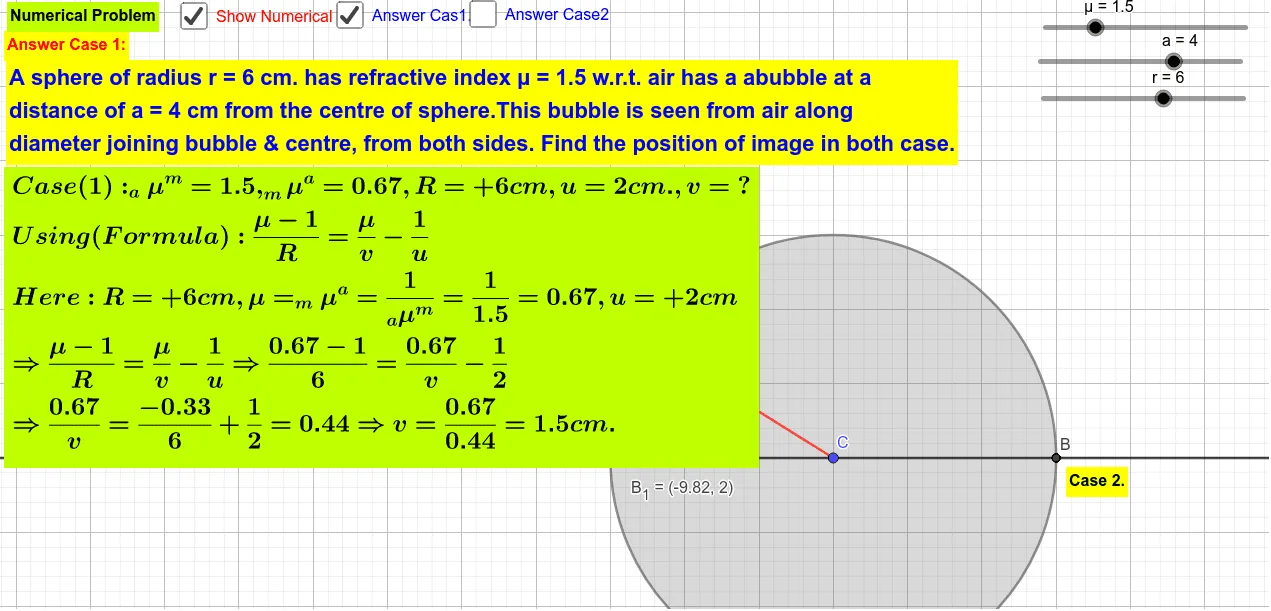
This example demonstrates the geometric phenomenon of light refraction through a curved surface. Key math concepts include refraction laws, curved geometry, and vector operations. Construction involves commands like Circle, Line, Intersect, Point, Ray, Vector, Angle, Rotate, Distance, Segment, Circumference, PointIn. Suitable for high school physics and mathematics education to understand curved optical principles.
GeoGebra Commands & Parameters
Circle(C, r) → cLine(C, xAxis) → dIntersect(c, d) → A, BPoint(c) → HRay(P, H) → gRay(C, H) → hVector(P, H) → uPoint(g) → IAngle(g, h) → αPoint(h) → JIntersect(c, d, 2) → KIntersect(c, d, 2) → NIntersect(c, d, 2) → OIntersect(c, d, 2) → SIntersect(c, d, 2) → TRotate(J, (-ar), H) → J'Angle(J', H, J) → βLine(H, J') → iIntersect(c, d, 1) → LIntersect(c, d, 1) → MIntersect(c, d, 1) → QIntersect(d, i) → RDistance(B, R) → distanceBRVector(H, J') → vSegment(R, H) → jSegment(C, J) → kVector(H, I) → wPoint(c) → URay(C, U) → lPoint(l) → VVector(C, V) → mRay(P, U) → nPoint(n) → WVector(P, U) → pVector(U, W) → qAngle(W, U, V) → θRotate(V, (-ar2), U) → V'Angle(V', U, V) → γLine(U, V') → sVector(U, V') → tIntersect(d, xAxis) → ZIntersect(d, xAxis) → A_1Intersect(s, d) → B_1Segment(U, B_1) → f_1Distance(A, B_1) → distanceAB1Distance(A, P) → distanceAPDistance(L, I) → LIDistance(C, P) → distanceCPDistance(C, B_1) → distanceCB1Circumference(c) → circumferencecPointIn(c) → Pointc
AI Drawing Prompt Reference
Draw a light refraction diagram through a curved surface. Start by drawing a circle c and a line d parallel to the x-axis, and find their intersection points A and B. Then, take a point H on circle c and draw two rays g and h from H, intersecting c at I and J respectively. Rotate J to get J', and find the angle β between J' and H. Draw a line i through H and J', intersecting d at R. Next, find other intersection points L, M, Q, and S of c and d, and the intersection point R of d and i. Calculate the distance distanceBR between B and R. Draw vector v from H to J', and draw line segments j and k from R and J to H. Continue by drawing vector w from H to I, taking a point U on circle c, drawing a ray l from C to U, finding the intersection point V of l and c, drawing vector m from C to V, and a ray n from P to U, finding the intersection point W of n and c, drawing vector p from P to U and q from W to U, and calculating the angle θ between V and U. Rotate V to get V', and find the angle γ between V' and U. Draw a line s through U and V', intersecting d at B_1. Draw line segment f_1 from U to B_1, and calculate the distances distanceAB1 between A and B_1, distanceAP between A and P, LI between L and I, and distanceCP between C and P.
The prompt above was compiled from the original drawing commands and is for reference only.