
Vertical Angles Theorem Demo
Loading the math board and drawing, please wait…
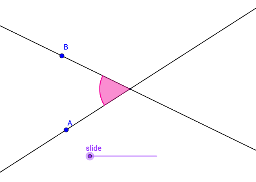
This example dynamically demonstrates the geometric meaning of the Vertical Angles Theorem through intersecting lines forming vertical angles. It covers core math concepts like angles, intersecting lines, and perpendicularity. Construction highlights include using GeoGebra commands/objects such as Circle, Point, Line, Intersect, Semicircle, CircleSector, Rotate, and CircleArc. Ideal for middle school and above students to visually grasp the equality of vertical angles and enhance spatial reasoning.
GeoGebra Commands & Parameters
Circle(A_1, 2) → cCircle(A_1, 5) → ePoint(e) → ALine(A_1, A) → gIntersect(e, g, 2) → DSemicircle(A, D) → dPoint(d) → BLine(A_1, B) → fIntersect(c, g, 2) → EIntersect(c, f, 2) → FCircleSector(A_1, F, E) → hRotate(h, (-α), A_1) → h'CircleArc(A_1, F, E) → k
AI Drawing Prompt Reference
Draw a geometric diagram demonstrating the vertical angles theorem. Start with two concentric circles sharing the same center, with different radii. Pick a point on the larger circle and draw a line from the center through this point, intersecting the larger circle again and the smaller circle once. Pick another point on the larger circle and draw a second line from the center through it, intersecting the smaller circle at another point. Connect the two intersection points on the smaller circle with an arc to form a sector, then rotate this sector to the opposite position to show the vertical angle. Finally, mark the arc between the two points on the smaller circle. The figure shows two intersecting lines creating two pairs of equal vertical angles.
The prompt above was compiled from the original drawing commands and is for reference only.