
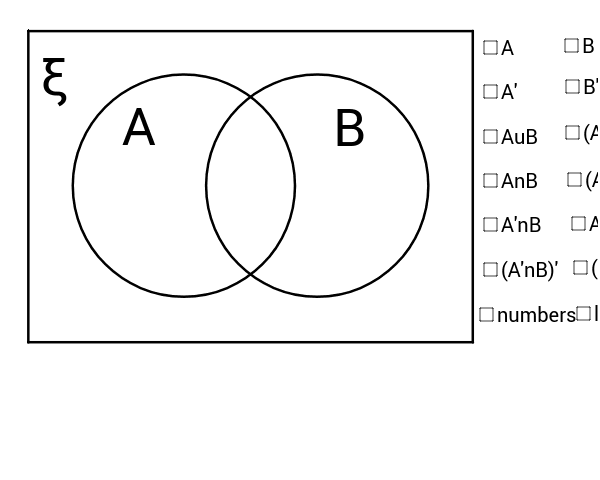
Venn Diagram for Set Theory with Movable Labels
Loading the math board and drawing, please wait…
In collections
CLASS 10
This GeoGebra example demonstrates an interactive Venn diagram for set theory, using movable letters and numbers to show the elements and values of each set. It visually illustrates set operations such as union, intersection, and complement within a universal set. Core mathematical concepts include set theory, set membership, subsets, and fundamental set operations. The construction relies on GeoGebra commands Point, Circle, Polygon, Intersect, and CircleArc, employing objects such as points A–F and Ubold, circles c_1, d_1, e, f, text labels text1–text3, arcs Aarc, Asarc, Bsarc, Barc, numeric or segment objects a, b, i, j, l, m, n, o, q, r, s, t, and shaded regions Ashade, Bshade, Ushade together with polygons K_2, K_3, K_4. It is suitable for secondary school set theory lessons and introductory discrete mathematics courses at the university level.
GeoGebra Commands & Parameters
Point(yAxis) → ACircle(A, 5) → AboldPoint(xAxis) → BCircle(B, 5) → BboldPolygon(C, D, E, F) → Ubold, c_1, d_1, e, fIntersect(Abold, Bbold, 1) → GIntersect(Abold, Bbold, 2) → HCircleArc(A, G, H) → AarcCircleArc(B, G, H) → AsarcCircleArc(A, H, G) → BsarcCircleArc(B, H, G) → BarcCircle(A, 5) → AshadeCircle(B, 5) → BshadePolygon(C, D, E, F) → Ushade, K_2, K_3, K_4, K_5Circle(A, 5) → AwhiteCircle(B, 5) → BwhiteCircleArc(B, G, H) → AsarcwhiteCircleArc(A, H, G) → BsarcwhiteCircleArc(A, H, G) → BsarcxCircleArc(B, G, H) → Asarcx