
Vectors in Naval Battle
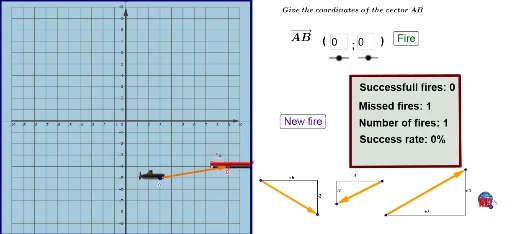
Loading the math board and drawing, please wait…
This example simulates vector movements in a naval battle to demonstrate basic vector concepts and operations. It involves vector addition, subtraction, and logical operations. Using GeoGebra commands such as Vector, plusk, and If, users can intuitively understand the geometric meaning and operational rules of vectors. Suitable for students at the junior high school level and above to learn the basics of vector knowledge.
GeoGebra Commands & Parameters
Random(-6, 6) → aVector((0, 0), (0, 0.07)) → zVector((0, 0), (0.055, 0)) → wVector((0, 0), (1, 0)) → cVector((0, 0), (0, 1)) → d_1wybuch(C, Vector[(4 * w)], Vector[(2 * z)]) → poly1plusk(C) → liste5If(total ≟ 0, 0, round((100 * reussi / total))) → tauxTextfield(m) → TextechampTextfield(n) → ChampTexte1Vector(A, B) → eElement(liste2, 4) → PPSequence(Segment[(Element[liste2, i], -10), (Element[liste2, i], 10)], i, 1, Length[liste2]) → liste3Sequence(Segment[(-10, Element[liste2, i]), (10, Element[liste2, i])], i, 1, Length[liste2]) → liste4Vector((-10, 0), (10, 0)) → uVector((0, -10), (0, 10)) → vPolygon(AA, BB, 4) → poly2, aa, bb, g, h, E, FPolygon(J, G, H, I) → poly3, j_1, g_1, h_1, i_1Polygon(K, L, M, N) → poly4, k, l, m_1, n_1Vector(O, P) → qLine(O, xAxis) → rLine(P, yAxis) → sIntersect(r, s) → QVector(R, S) → tLine(R, xAxis) → a_1Line(S, bb) → b_1Intersect(b_1, a_1) → TSegment(O, Q) → c_1Segment(P, Q) → e_1Segment(T, R) → f_1Segment(T, S) → k_1Vector(U, V) → u_1Line(U, xAxis) → l_1Line(V, bb) → p_1Intersect(p_1, l_1) → WSegment(U, W) → q_1Segment(W, V) → r_1Midpoint(c_1) → ZMidpoint(f_1) → A_1Midpoint(k_1) → B_1Midpoint(q_1) → C_1Midpoint(r_1) → D_1Midpoint(e_1) → E_1Segment(E - (0, 1.4), F - (0, 1.4)) → s_1