
Vector Equality Practice
Loading the math board and drawing, please wait…
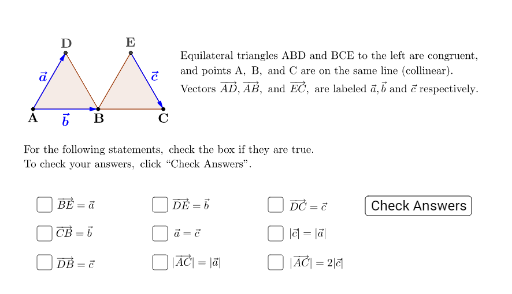
This example demonstrates how to explore vector equality using polygons and vector operations. Built with GeoGebra commands Polygon, Vector, and Sum, it constructs two polygons and defines vectors a, b, c, allowing users to verify relationships such as a + b = c. The core mathematical concepts include the parallelogram law of vector addition, the polygon law, coordinate geometry representation, and applications of vectors in geometric figures. The construction utilizes polygon objects, vector objects, and text feedback controls, making it suitable for high‑school or early university students learning vector concepts, as well as for classroom practice and self‑directed exploration.
GeoGebra Commands & Parameters
Polygon(A, B, 3) → poly1, a_1, b_1, c_1, DPolygon(B, C, 3) → poly2, d, e, f, EVector(A, D) → aVector(A, B) → bVector(E, C) → cSum(Answers) → Total
AI Drawing Prompt Reference
Draw two triangles and represent vector a as a vector from the first vertex of the first triangle to the fourth point, vector b as a vector from the first vertex to the second point, and vector c as a vector from the fourth vertex of the second triangle to its base point, demonstrating that vector a plus vector b equals vector c using polygons and vector operations to verify the parallelogram law and polygon law of vector addition.
The prompt above was compiled from the original drawing commands and is for reference only.