
Vector Described in Terms of Scalar Components
Loading the math board and drawing, please wait…
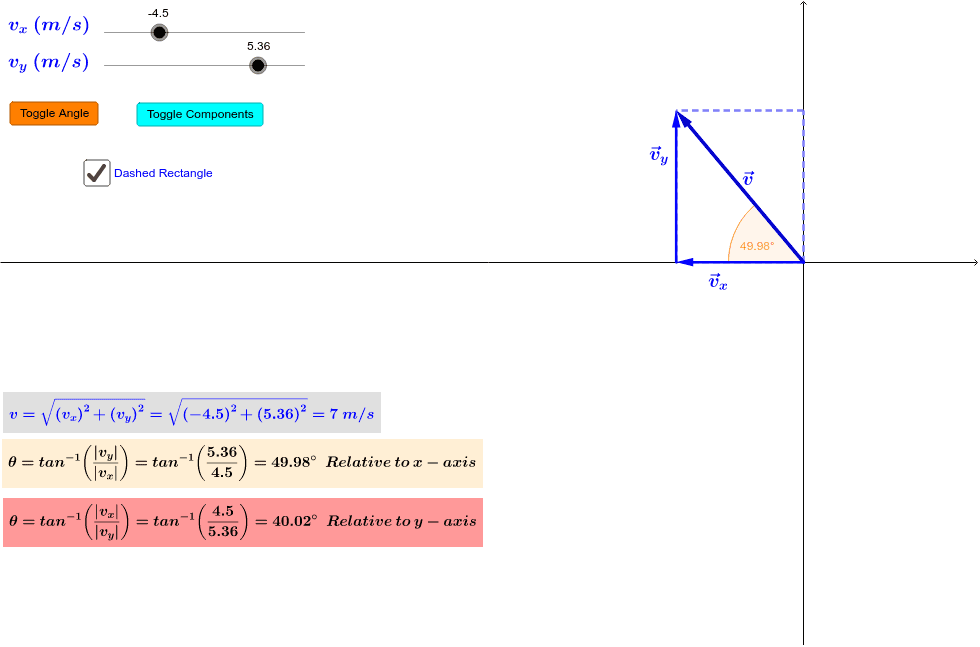
This example demonstrates how to describe and visualize a vector in a coordinate system using scalar components. It involves core mathematical concepts like vectors, scalar components, angles, coordinate geometry, and trigonometry. The construction uses GeoGebra commands such as Vector, Angle, Line, Segment, and objects like v_{y-scalar}, v_{x-scalar}, vv_x, vv_y. It is suitable for high school and above students learning about vector applications in mathematics.
GeoGebra Commands & Parameters
Vector(A, B) → vVector(A, C) → v_xVector(C, B) → vv_yAngle(v, v_x) → InnerAngle_xLine((0, 0), v) → aAngle(xAxis, a) → OuterAngleVector(A, D) → v_yAngle(v, v_y) → InnerAngle_yVector(D, B) → vv_xSegment(A, D) → ysideSegment(A, C) → xsideSegment(D, B) → xxsideSegment(C, B) → yysideAngle(a, yAxis) → Bearing
AI Drawing Prompt Reference
Draw a vector v and its scalar components v_x and v_y on the coordinate system. Start by drawing vector v, then draw its x-component v_x and y-component v_y. Next, draw the angle between vector v and the x-axis, InnerAngle_x, and the angle between vector v and the y-axis, InnerAngle_y. Finally, draw the angles between the x-axis and y-axis with vector v, Bearing, and the auxiliary lines for v_x and v_y.
The prompt above was compiled from the original drawing commands and is for reference only.