
Vector Addition Using Scalar Components
Loading the math board and drawing, please wait…
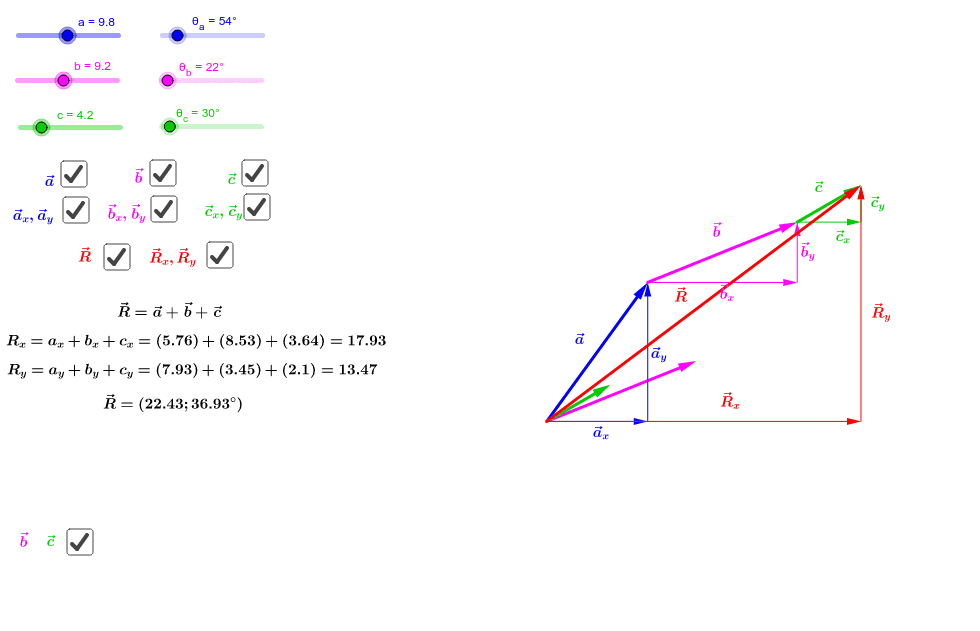
This example demonstrates vector addition using scalar components, visually illustrating the process of vector composition and decomposition. Core math concepts include vectors, scalar components, vector addition, and coordinate geometry. It constructs vectors using the Vector command, involving objects like A, a, θ_a, b, θ_b, c, θ_c, vec_a, vec_b, vec_c, B, C, u, D, v, Bx, Cx, Dx, w, d, e, f, g, h, etc., showcasing geometric representation of vector operations. Suitable for high school and above students learning vector operations, physics mechanics, or engineering applications.
GeoGebra Commands & Parameters
Vector(B, C) → uVector(C, D) → vVector(A, Bx) → wVector(Bx, B) → dVector(B, Cx) → eVector(Cx, C) → fVector(C, Dx) → gVector(Dx, D) → hVector(A, D) → iVector(A, Dxx) → jVector(Dxx, D) → k
AI Drawing Prompt Reference
Draw a vector addition diagram starting from a common origin. First, draw a horizontal vector, then a vertical vector from its tip, forming a right triangle. From the origin, draw a diagonal vector representing their sum. At the tip of the horizontal vector, draw its horizontal and vertical component vectors with right-angle marks; similarly, at the tip of the vertical vector, draw its components. Finally, from the origin, draw another vector parallel to the sum but with a different length, and add a vertical component at its tip to form another right triangle, illustrating vector decomposition and composition.
The prompt above was compiled from the original drawing commands and is for reference only.