
Vector Addition Using Scalar Components (Version 2)
Loading the math board and drawing, please wait…
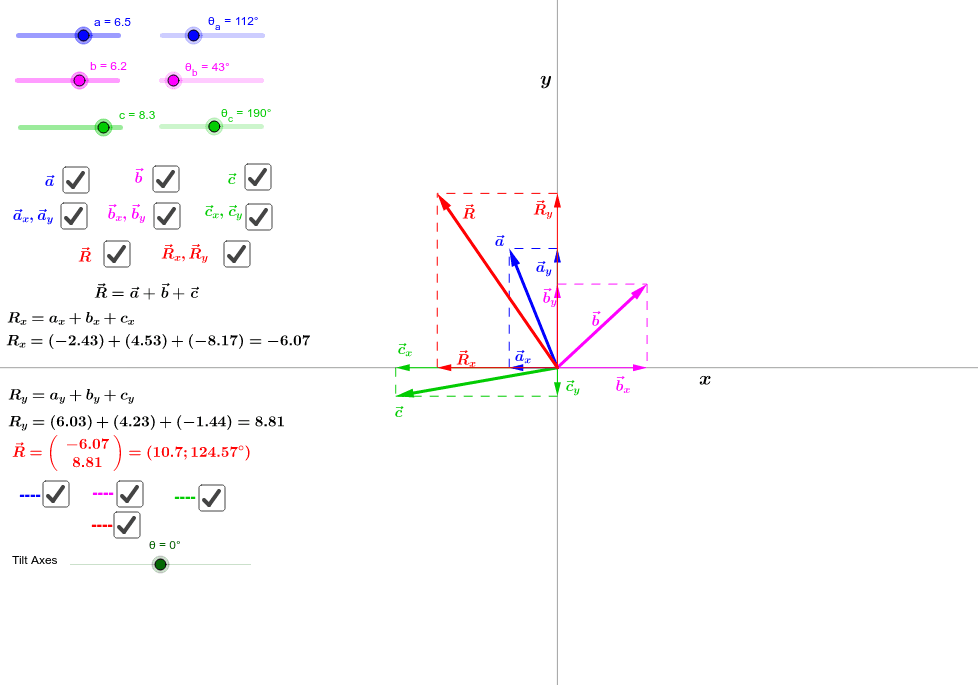
This example demonstrates vector addition using scalar components, visualizing the result geometrically. Key math concepts include vectors, scalar components, vector addition, and coordinate geometry. Constructed with GeoGebra commands like Line, Segment, Point, Angle, and objects such as θ, θ_a, a, O, b, θ_b, c, vec_a, etc. Suitable for high school students and above to understand the geometric meaning of vector operations, and for use in related math competitions as an auxiliary teaching tool.
GeoGebra Commands & Parameters
Line(O, ivec) → dLine(O, jvec) → eSegment(Ay, A) → fSegment(B_y, B) → gSegment(C, C_y) → hSegment(Ax, A) → iSegment(C_x, C) → jSegment(B, B_x) → kSegment(S, T) → tSegment(U, T) → a_1Segment(O, B) → b_1Segment(O, A) → c_1Segment(O, C) → d_1Point(e) → VPoint(d) → WPoint(d) → ZPoint(e) → A_1Segment(O, V) → e_1Segment(O, Z) → g_1Segment(O, A_1) → h_1Segment(O, W) → i_1Angle(c_1, g_1) → θ2xAngle(c_1, e_1) → θ2yAngle(b_1, e_1) → θ1yAngle(b_1, i_1) → θ1xAngle(d_1, g_1) → θ3xAngle(d_1, h_1) → θ3yAngle(ivec, vec_R) → R_{angle}