
V. Pantaloni Chord Problem: Dynamic Geometry
Loading the math board and drawing, please wait…
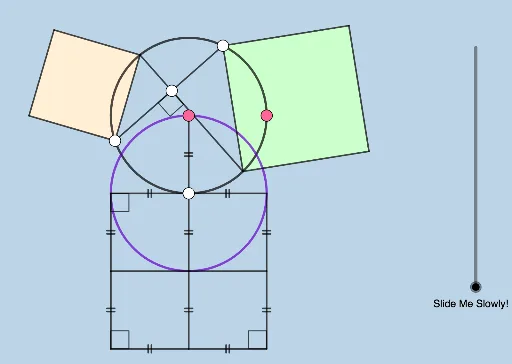
This dynamic GeoGebra example illustrates and allows modification of a geometry problem posted by Vincent Pantaloni on Twitter, involving circles, chords, polygons, and various transformations. Core mathematical concepts include properties of circles, relationships between chords and angles, similarity transformations, translation, rotation, reflection, and measurement of distances and angles. The construction uses GeoGebra commands such as Circle, Point, Segment, OrthogonalLine, Intersect, Polygon, Radius, Line, Mirror, Angle, Distance, Midpoint, Min, Vector, Dilate, Translate, Ray, and Rotate, creating multiple points, segments, polygons, and auxiliary lines that can be dynamically adjusted via sliders or dragging. Suitable for high school and above, this resource helps students and teachers explore geometric problems, understand transformations and similarity, and serves as material for mathematical modeling or competition preparation.
GeoGebra Commands & Parameters
Circle(A, B) → cPoint(c) → CPoint(c) → DSegment(C, D) → fPoint(f) → EOrthogonalLine(E, f) → gIntersect(c, g, 2) → FIntersect(c, g, 1) → GPolygon(D, G, 4) → poly1, h, i, j, k, H, IPolygon(C, F, 4) → poly2, l, m, n, p, J, KRadius(c) → aPoint(c) → LLine(A, L) → qOrthogonalLine(L, q) → rCircle(L, Distance[A, L]) → eIntersect(e, r, 1) → MIntersect(e, r, 2) → NOrthogonalLine(M, r) → sOrthogonalLine(N, r) → tIntersect(e, q, 2) → OOrthogonalLine(O, q) → f_1Mirror(N, O) → N'Mirror(M, O) → M'Intersect(s, f_1) → PIntersect(f_1, t) → QLine(N', M') → g_1Intersect(q, g_1) → RAngle(D, E, F) → αSegment(A, L) → h_1Segment(L, O) → i_1Segment(M, P) → j_1Segment(P, O) → k_1Segment(O, Q) → l_1Segment(Q, N) → m_1Segment(Q, M') → n_1Segment(M', R) → p_1Segment(R, O) → q_1Segment(P, N') → r_1Segment(N', R) → s_1Segment(M, L) → t_1Segment(L, N) → a_1Distance(J, F) → oDistance(D, G) → uSegment(F, G) → b_1Line(D, J) → e_1Midpoint(J, C) → TMin({poly1, poly2}) → o_1Midpoint(D, H) → UVector(T, O) → wDistance(D, I) → d_1Distance(A, B) → c_1Line(F, J) → f_2Circle(C, (2 * c_1)) → c_2Intersect(c_2, f_2, 2) → SSegment(J, K) → h_2Segment(K, C) → m_2Segment(C, F) → n_2Dilate(F, If[0 < v ≤ 1, 1 - v, 0], S) → F'_1Vector(F, F'_1) → u_1Translate(J, u_1) → S'Polygon(K, C, F'_1, S') → q1, k_2, c_3, f'_1, s'Ray(F, J) → i_2Line(S', K) → j_2Line(C, K) → p_2Distance(K, S') → v_1Line(C, S) → g_2OrthogonalLine(S', g_2) → l_2Intersect(g_2, l_2) → VDilate(S, If[2 < v ≤ 3, 3 - v, 0], V) → S'_1Vector(S, S'_1) → u_2Translate(C, u_2) → C'Polygon(S', K, C', S'_1) → q2, q_2, r_2, s_2, t_2Segment(J, F) → a_2Dilate(C', If[4 < v ≤ 5, 5 - v, 0], N) → C''Vector(C', C'') → v_2Translate(S', v_2) → S''Translate(K, v_2) → K'Translate(C', v_2) → C''_1Translate(S'_1, v_2) → WPolygon(S'', K', C''_1, W) → q2', s'', k', c''_1, w_2Line(C', K) → b_2Line(N, b_2) → d_2Point(d_2) → ZAngle(Z, N, Q) → βRotate(S'', If[5 < v ≤ 6, ((v - 5) * β), β], N) → S'''Rotate(K', If[5 < v ≤ 6, ((v - 5) * β), β], N) → K''Rotate(C''_1, If[5 < v ≤ 6, ((v - 5) * β), β], N) → A_1Rotate(W, If[5 < v ≤ 6, ((v - 5) * β), β], N) → W'Polygon(S''', K'', A_1, W') → q2'', s''', k'', e_2, w'Dilate(S''', If[6 < v ≤ 7, 7 - v, 0], N') → B_1Vector(S''', B_1) → u_3Translate(S''', u_3) → C_1Translate(K'', u_3) → K'''Translate(A_1, u_3) → D_1Translate(W', u_3) → W''Polygon(C_1, K''', D_1, W'') → q2''', f_3, k''', g_3, w''Segment(D, I) → h_3Segment(I, H) → i_3Segment(H, G) → j_3Segment(G, D) → k_3Line(D, I) → l_3Circle(G, (2 * c_1)) → d_3Intersect(d_3, l_3) → E_1, F_2Dilate(D, If[7 < v ≤ 8, 8 - v, 0], E_1) → D'Vector(D, D') → v_3Translate(I, v_3) → I'Polygon(G, H, I', D') → q3, g_4, h_4, i', d'Line(I', H) → m_3OrthogonalLine(G, m_3) → n_3Intersect(m_3, n_3) → F_1Dilate(H, If[9 < v ≤ 10, 10 - v, 0], F_1) → H'Vector(H, H') → w_3Translate(I', w_3) → I''Polygon(E_1, I'', H', G) → q4, p_3, i'', h', g_5Dilate(G, If[11 < v ≤ 12, 12 - v, 0], N) → G'Vector(G, G') → a_3Translate(E_1, a_3) → G_1Translate(I'', a_3) → I'''Translate(H', a_3) → H''Translate(G, a_3) → G'_1Polygon(G_1, I''', H'', G'_1) → q4', q_3, i''', h'', g'_1Line(G_1, N) → r_3Angle(G_1, N, M) → γRotate(G_1, If[12 < v ≤ 13, ((v - 12) * γ), γ], N) → H_1Rotate(I''', If[12 < v ≤ 13, ((v - 12) * γ), γ], N) → I_1Rotate(H'', If[12 < v ≤ 13, ((v - 12) * γ), γ], N) → H'''Rotate(G'_1, If[12 < v ≤ 13, ((v - 12) * γ), γ], N) → J_1Polygon(H_1, I_1, H''', J_1) → q4'', s_3, t_3, h''', b_3Dilate(N, If[13 < v ≤ 14, 14 - v, 0], D_1) → N'_1Vector(N, N'_1) → e_3Translate(H_1, e_3) → K_1Translate(I_1, e_3) → L_1Translate(H''', e_3) → M_1Translate(J_1, e_3) → N_1Polygon(K_1, L_1, M_1, N_1) → q4''', f_4, i_4, j_4, k_4Angle(P, M, L) → δAngle(R, N', P) → εAngle(Q, M', R) → ζLine(C, K) → m_4Line(F, J) → l_4Line(K, S') → p_4Line(C, S'_1) → n_4Line(G, H) → q_4Line(I', F_1) → r_4Line(E_1, G) → s_4
AI Drawing Prompt Reference
Draw a dynamic geometry illustration featuring two circles and their intersection points, forming two quadrilaterals. One circle's diameter is a segment, and the other circle's diameter is perpendicular to this segment. Construct two quadrilaterals from these points and lines, highlighting their similarity and symmetry. Include auxiliary lines, angle and distance measurements, and transformations like rotation, reflection, and translation to demonstrate geometric properties.
The prompt above was compiled from the original drawing commands and is for reference only.