
Unit Circle 3
Loading the math board and drawing, please wait…
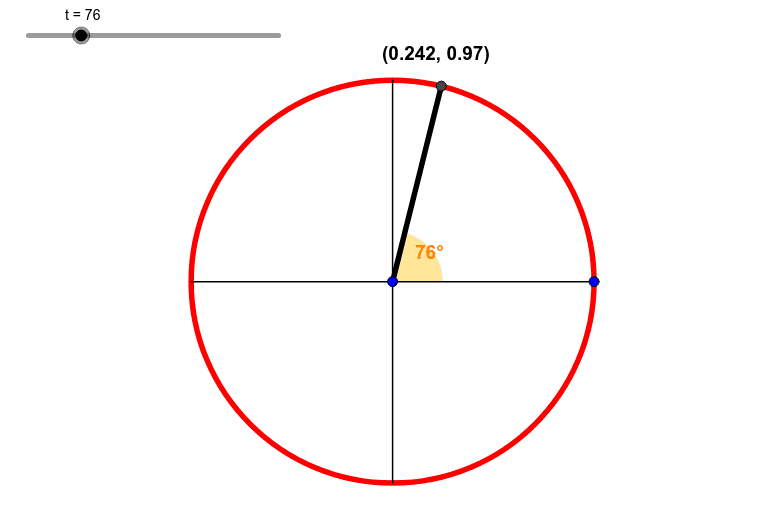
This example demonstrates the geometric construction of a unit circle. Key mathematical concepts include the properties of circles and geometric constructions. Using GeoGebra commands such as Circle, Polygon, Angle, and Vector, the example dynamically shows various parts of the unit circle. Suitable for high school mathematics education and learning.
GeoGebra Commands & Parameters
Corner(text1, 4) → ICorner(text1, 3) → FCorner(text1, 1) → DMidpoint(D, F) → GCircle(A, B) → cRay(A, C) → fCorner(text1, 2) → HPolygon(I, D, H, F) → poly1, i, d, h, f_1Ray(G, M) → gSegment(A, C) → jAngle(B, A, C) → αAngularBisector(B, A, C) → mCorner(text3, 1) → OCorner(text3, 3) → PSegment(O, P) → nCircle(A, n) → pVector(H, D) → uIntersect(e, f, 1) → JSegment((-1, 0), (1, 0)) → qSegment((0, 1), (0, -1)) → r
AI Drawing Prompt Reference
Draw a unit circle with a radius of 1 centered at point O. Use the circle tool to draw the circle, and construct a diameter with its midpoint G. Mark four key points I, D, H, and F on the circle and connect them to form a quadrilateral. Draw a perpendicular bisector of the diameter using points O and P. Draw two tangent lines on the circle through points H and D, and find their intersection point J with the diameter. Draw the unit line segments of the x-axis and y-axis to form the coordinate axes of the unit circle.
The prompt above was compiled from the original drawing commands and is for reference only.