
Cube Dissection: Geometry and Linear Programming
Loading the math board and drawing, please wait…
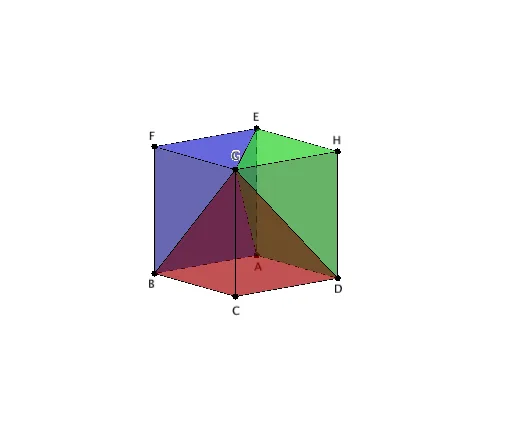
This example demonstrates cube dissection using GeoGebra, highlighting the application of linear programming in geometric optimization. Key mathematical concepts include solid geometry, linear optimization, and rational numbers. Construction involves using Polygon and Pyramid commands to create polyhedra, with parameters like a, b, c, d controlling the dissection. Suitable for high school students learning geometric optimization or for math modeling education.
GeoGebra Commands & Parameters
Polygon(A_1, B_1, C_1, D_1) → poly1, a, b, c, dPyramid(poly1, G_1) → e, face1, face3, face4, face2, edge1, edge2, edge3, edge4Polygon(A_2, B_2, F_2, E_2) → poly2, a_2, b_2, f_2, e_2Pyramid(poly2, G_2) → f, face5, face7, face8, face6, edge5, edge6, edge8, edge7Polygon(A_3, E_3, H_3, D_3) → poly3, a_3, e_3, h_3, d_3Pyramid(poly3, G_3) → g, face10, face12, face11, face9, edge9, edge12, edge11, edge10
AI Drawing Prompt Reference
Construct a geometric model of a cube dissection showing a cube divided into three pyramid-shaped solids. The first pyramid has a quadrilateral base with its apex meeting at a point above. The second pyramid also features a quadrilateral base positioned on one side of the cube. The third pyramid similarly uses a quadrilateral as its base on another face of the cube. These three pyramids together form a complete cube divided by cutting planes, demonstrating the geometric construction of partitioning a cube into multiple pyramidal solids.
The prompt above was compiled from the original drawing commands and is for reference only.