
Visual Pythagorean Theorem Demonstration
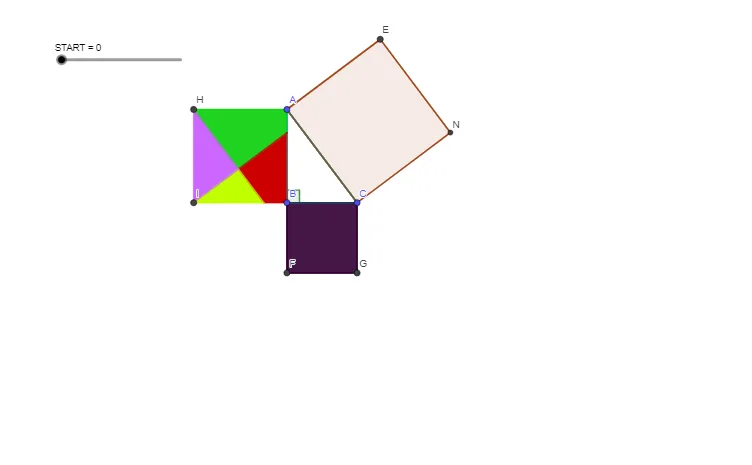
Loading the math board and drawing, please wait…
This example visually demonstrates the Pythagorean Theorem, illustrating that in a right triangle, the square of the length of the hypotenuse is equal to the sum of the squares of the other two sides. It involves core mathematical concepts such as right triangles, the Pythagorean theorem, similar triangles, polygon construction, vectors, and transformations. The construction uses GeoGebra commands/objects like Segment, Polygon, InteriorAngles, Line, Intersect, Circle, Vector, and Translate. Suitable for high school mathematics teaching or self-study to intuitively understand the theorem and its applications.
GeoGebra Commands & Parameters
Segment(A, B) → fSegment(B, C) → gSegment(C, A) → hPolygon(A, B, C) → t1, c, a, bInteriorAngles(t1) → α, β, γPolygon(A, C, 4) → poly1, i, j, k, l, D, EPolygon(C, B, 4) → poly2, m, n, p, q, F, GPolygon(B, A, 4) → poly3, r, s, t, d, H, ILine(H, k) → eLine(I, j) → f_1Intersect(e, f_1) → JCircle(D, Segment[H, J]) → c_1Intersect(e, d) → KIntersect(f_1, f) → LIntersect(c_1, k, 1) → MVector(C, S) → uVector(J, O) → vVector(J, R) → wVector(J, Q) → u_1Vector(J, P) → v_1Polygon(H, A, L, J) → q1, h_1, a_1, l_1, j_1Polygon(J, L, B, K) → q2, j_2, l_2, b_1, k_1Polygon(I, K, J) → t2, j_3, i_1, k_2Polygon(H, I, J) → t3, j_4, h_2, i_2Translate(poly2, u) → poly2'Translate(H, v_1) → H'Translate(A, v_1) → A'Translate(L, v_1) → L'Translate(J, v_1) → J'Polygon(H', A', L', J') → q1', h', a', l', j'Translate(H, v_1) → H'_1Translate(A, v_1) → A'_1Translate(L, v_1) → L'_1Translate(J, v_1) → J'_1Polygon(H'_1, A'_1, L'_1, J'_1) → q1'_1, h'_1, a'_1, l'_1, j'_1Translate(H, u_1) → H'_2Translate(I, u_1) → I'Translate(J, u_1) → J'_2Polygon(H'_2, I', J'_2) → t3', j'_2, h'_2, i'Translate(I, w) → I'_1Translate(K, w) → K'Translate(J, w) → J'_3Polygon(I'_1, K', J'_3) → t2', j'_3, i'_1, k'Translate(J, v) → J'_4Translate(L, v) → L'_2Translate(B, v) → B'Translate(K, v) → K'_1Polygon(J'_4, L'_2, B', K'_1) → q2', j'_4, l'_2, b', k'_1Intersect(j, k) → N
AI Drawing Prompt Reference
Draw a right triangle with squares constructed outward on each of its three sides. Inside the square on the hypotenuse, divide it into two parallelograms and two triangles by connecting vertices and intersection points. Then translate and rotate the squares on the two legs so they fit into the hypotenuse square, visually demonstrating that the sum of their areas equals the hypotenuse square's area. Include the right triangle, three squares, auxiliary lines, intersection points, a circle, and translated copies of the shapes, keeping all geometric relationships clear.
The prompt above was compiled from the original drawing commands and is for reference only.