
Unfolding a Cylinder Surface: Constructing the Lateral Area
Loading the math board and drawing, please wait…
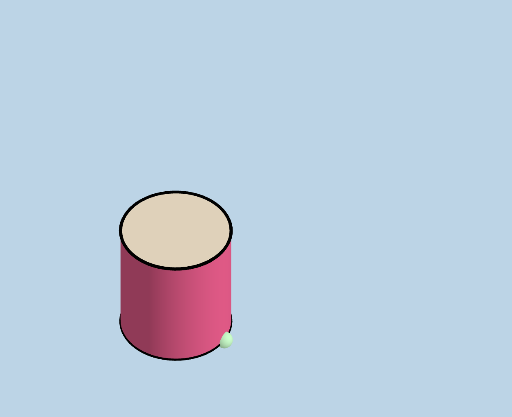
This example demonstrates how to unfold the lateral surface of a cylinder into a plane shape (a sector/rectangle-like development), making the lateral area relationship visually clear. Key mathematical ideas include cylinder–circle geometry, the isometry property of unfolding (arc length matches the cylinder’s base circumference), and computing area using fundamental parameters such as radius r and height h. Construction uses GeoGebra commands including Cylinder and Plane to define the solid and cutting surface, Intersect to obtain intersection elements, and Rotate/Translate/Mirror to map the curved surface into its planar development. Boundaries and geometric relations are built with CircleArc, Polygon, Segment, Angle, and CurveCartesian. Additional commands—Sphere, Line, Vector, Dilate, Surface, and Midpoint—support auxiliary geometry for directions, scaling, key points, and surface visualization, while correspondingly labeled objects (e.g., A, B, C, C' variants, K/K', L, D') track the before/after mapping. Suitable for middle and high school geometry lessons on surface area and for learner exploration of geometric transformations and curve unfolding.
GeoGebra Commands & Parameters
Cylinder(A, C, r) → a, c, d, bLine(D, E) → fIntersect(f, d, 1) → FSphere(F, r) → eIntersect(f, e) → G, HPlane(G, F, C) → gRotate(C, If[0 < i ≤ 1, (i * pi / 2), pi / 2], D, g) → C'Rotate(d, If[0 < i ≤ 1, (i * pi / 2), pi / 2], D, g) → d'Rotate(dd, If[0 < i ≤ 1, (i * pi / 2), pi / 2], D, g) → dd'Dilate(C, If[1 < i ≤ 2, 2 - i, 0], I) → C'_1Dilate(C, If[1 < i ≤ 2, 2 - i, 0], J) → C'_2Vector(C, C'_1) → uVector(C, C'_2) → vTranslate(dd, u) → dd'_1Translate(dd, v) → dd'_2Translate(K, u) → K'Translate(K, v) → K'_1Rotate(K', If[1 < i ≤ 2, ((i - 1) * pi), pi], C'_1) → K''Rotate(K'_1, If[1 < i ≤ 2, ((-(i - 1)) * pi), (-pi)], C'_2) → LTranslate(D, u) → D'Translate(D, v) → D'_1Polygon(D', D'_1, N, M) → poly1, d'_1, d'_2, n, mSegment(K'', Q) → jCircleArc(P, Q, M) → kSegment(L, S) → lCircleArc(R, N, S) → pCircleArc(C'_2, D'_1, L) → qCircleArc(C'_1, K'', D') → sPlane(T, A, B) → oRotate(C', If[2 < i ≤ 3, ((i - 2) * pi / 2), pi / 2], E, g) → C''Rotate(poly1, If[2 < i ≤ 3, ((i - 2) * pi / 2), pi / 2], E, g) → poly1'Rotate(d', If[2 < i ≤ 3, ((i - 2) * pi / 2), pi / 2], E, g) → d'_3Rotate(dd', If[2 < i ≤ 3, ((i - 2) * pi / 2), pi / 2], E, g) → dd'_3Rotate(K'', If[2 < i ≤ 3, ((i - 2) * pi / 2), pi / 2], E, g) → K'''Rotate(Q, If[2 < i ≤ 3, ((i - 2) * pi / 2), pi / 2], E, g) → Q'Segment(K''', Q') → j'Rotate(L, If[2 < i ≤ 3, ((i - 2) * pi / 2), pi / 2], E, g) → L'Rotate(S, If[2 < i ≤ 3, ((i - 2) * pi / 2), pi / 2], E, g) → S'Segment(L', S') → l'Dilate(C'', If[3 < i ≤ 4, 4 - i, 0], U) → C'''Vector(C'', C''') → wDilate(C'', If[3 < i ≤ 4, 4 - i, 0], V) → C'''_1Vector(C'', C'''_1) → tTranslate(Z, w) → Z'Translate(Z, t) → Z'_1Translate(W, w) → W'Translate(W, t) → W'_1Rotate(W', If[3 < i ≤ 4, ((-(i - 3)) * pi), (-pi)], C''') → W''CircleArc(C''', Z', W'') → c_1Segment(Z, Z') → f_1Rotate(W'_1, If[3 < i ≤ 4, ((i - 3) * pi), pi], C'''_1) → A_1CircleArc(C'''_1, Z'_1, A_1) → d_1Segment(Z, Z'_1) → g_1Segment(R, N) → h_1Angle(N, R, S) → αCurveCartesian(x(C'_2) + (r * cos(t)), y(C'_2) + (r * sin(t)), z(C'_2), t, pi / 2, pi / 2 + α) → a_1Vector(A, C) → ttSurface(x(C'_2) + (r * cos(t)) - (u * x(tt)), y(C'_2) + (r * sin(t)) - (u * y(tt)), z(C'_2) - (u * z(tt)), u, 0, 1, t, pi / 2, pi / 2 + α) → b_1Surface((-x(C'_2)) - (r * cos(t)) - (u * x(tt)), y(C'_2) + (r * sin(t)) - (u * y(tt)), z(C'_2) - (u * z(tt)), u, 0, 1, t, pi / 2, pi / 2 + α) → e_1Midpoint(L', S') → B_1Midpoint(K''', Q') → C_1Line(B_1, C_1) → i_1Mirror(d_1, i_1) → k_1Mirror(c_1, i_1) → p_1Mirror(Z, i_1) → Z'_2Mirror(Z', i_1) → Z''Segment(Z'_2, Z'') → j_1Mirror(Z, i_1) → Z'_3Mirror(Z'_1, i_1) → D_1Segment(Z'_3, D_1) → l_1
AI Drawing Prompt Reference
Draw the lateral surface of a cylinder unfolded into a plane shape, such as a sector or rectangle. Start by constructing a cylinder and a plane to cut it. Find the intersection points between the cylinder and the plane. Map the curved surface onto the plane using rotations and translations to form the development. Use arcs and polygons to outline the unfolded shape, connecting key points with lines. Finally, adjust the figure through rotations and scaling to clearly show the relationship between the lateral area and the cylinder's base circumference and height.
The prompt above was compiled from the original drawing commands and is for reference only.