
UCSS Math III 4A.1.5 Example 1
Loading the math board and drawing, please wait…
In collections
UCSS Secondary Math III Unit 4A Lesson 1
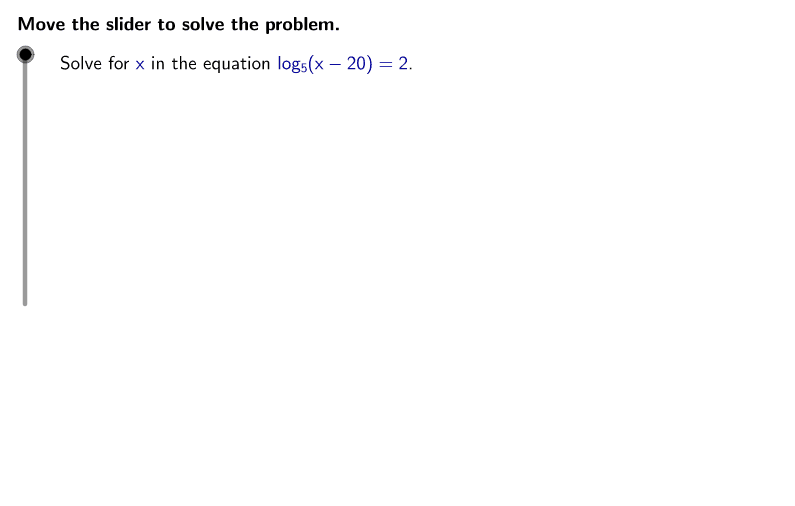
This example demonstrates how to solve the logarithmic equation [math]\log_5 (x – 20) = 2[/math]. The core mathematical concepts involved include logarithms, logarithmic functions, and solving equations. Construction highlights: Utilizes LaTeX commands and Corner objects, step control (stepMax, stepper, steps, counter), and randomization text (RandomizationText, Original, Randomized) among other GeoGebra objects. Suitable for high school mathematics courses or teaching logarithmic functions.
GeoGebra Commands & Parameters
LaTeX(steps) → counterLaTeX("\text{Use the buttons below to return to the original problem or}\cr\text{randomly generate a similar practice problem.}") → RandomizationTextCorner(1) → ACorner(3) → BLaTeX((((((("\textcolor{#000099}{log_{" * base) * "}(x-") * subtract) * ")=") * constant) * "}")) → text4LaTeX("\text{Simplify the left side of the equation using the fact that }\textcolor{#000099}{a^{\log_{a}(x)}=x}\text{. Simplify the}\cr\text{power on the right side of the equation.}") → text7LaTeX((("\textcolor{#000099}{x=" * Simplify[base^(constant) + subtract]) * "}")) → text10LaTeX((((((((("\text{The value of }\textcolor{#000099}{x}\text{ in the logarithmic equation }\textcolor{#000099}{\log_{" * base) * "}(x-") * subtract) * ")=") * constant) * "}\text{ is }\textcolor{#000099}{") * Simplify[base^(constant) + subtract]) * "}.")) → text11LaTeX((((((("\text{Solve for }\textcolor{#000099}{x}\text{ in the equation }\textcolor{#000099}{log_{" * base) * "}(x-") * subtract) * ")=") * constant) * "}.")) → ProblemLaTeX("\text{Notice that }\textcolor{#000099}{x}\text{ is in the argument of the logarithm. In order to extract }\textcolor{#000099}{x}\text{ from the argument of any function, }\cr\text{apply the inverse of the function to both sides of the equation.") → text1LaTeX("\text{Given logarithmic equation}") → text3LaTeX("\textcolor{#000099}{y=\log_{a}(x)}") → text2_1LaTeX("\textcolor{#000099}{a^y=x}") → text2_2LaTeX((((((("\textcolor{#000099}{(" * base) * ")^{(") * constant) * ")}=(x-") * subtract) * ")}")) → text6LaTeX("\text{Solve the result for x.}") → text5_1LaTeX("\text{Rewrite in exponential form.}") → text3_1LaTeX((((((("\textcolor{#000099}{(" * base) * ")^{(") * constant) * ")}=(x-") * subtract) * ")}")) → text6_1LaTeX("\text{Exponential form of the original equation}") → text5_2LaTeX((((("\textcolor{#000099}{" * Simplify[base^(constant)]) * "=x-") * subtract) * "}")) → text8LaTeX("\text{Rewrite the equation in exponential form.}") → text5_3LaTeX("\text{Simplify.}") → text5LaTeX("\text{Move the slider to solve the problem.}") → text0LaTeX("\text{General form of a logarithmic equation}") → text3_2LaTeX("\text{A logarithmic equation of the form }\textcolor{#000099}{y=\log_{a}(x)}\text{ can be rewritten }\cr\text{as an exponential equation of the form }\textcolor{#000099}{a^y=x}.") → text2LaTeX((((((((((((("\text{The logarithmic equation }\textcolor{#000099}{log_{" * base) * "}(x-") * subtract) * ")=") * constant) * "}\text{ can be rewritten}\cr\text{as an exponential equation of the form }\textcolor{#000099}{(") * base) * ")^{(") * constant) * ")}=(x-") * subtract) * ").}")) → text2_3