
Truncated Icosahedron (V=60) from a Biscribed Pentakis Dodecahedron via 3rd-Orde
Loading the math board and drawing, please wait…
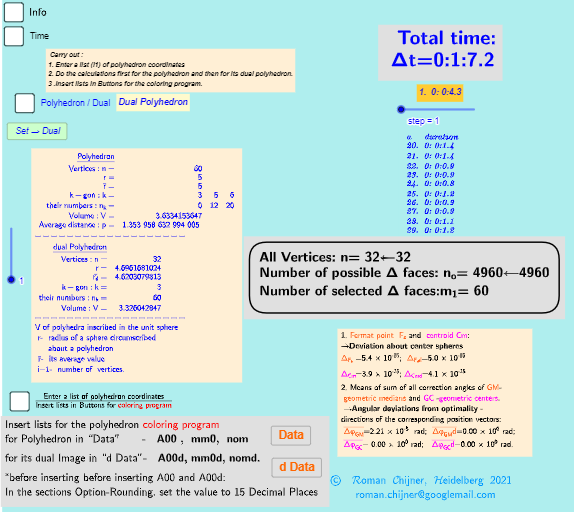
This example demonstrates how to construct a Truncated Icosahedron (with V=60) starting from a biscribed Pentakis Dodecahedron, specifically for the case where the relevant 3rd-order segments are trisected. The construction couples a solid-geometry transformation (cutting/truncation) with algebraic computation: conditional branching (If) selects the appropriate geometric setup for the chosen trisection case; segment handling is managed through discrete sequences and indexed lookup (Sequence, IndexOf, Element, First) combined with division (Div); metric quantities are obtained via Length; intermediate and aggregated values are computed using Sum and extremum selection via Max. The scene also uses Text and TableText to present key parameters and results, while multiple derived variables (including volume-related terms such as Volsphere/Vol and their radius-dependent counterparts) connect the 3D structure to quantitative outputs. Suitable for advanced secondary-level learners, geometry enrichment classes, and GeoGebra users who want to link polyhedral modeling with conditional logic and sequence-based parameterization.
GeoGebra Commands & Parameters
Text("" + p) → txt_pSum(Flatten[Sequence[Append[Sequence[Element[txt_p, i], i, m01(k), m02(k)], " "], k, 1, 5]]) → txtUm1If(bu0, A00, A00d) → A00_0Length(A00_0) → nLength(l2) → läl2Sequence(sgn(Determinant[{Element[A00_0, i1] - Element[A00_0, j], Element[A00_0, i2] - Element[A00_0, j], Element[A00_0, i3] - Element[A00_0, j]}]), j, 1, n) → l01Length(A00d) → zzzSum(Zip[(T * F), T, SysTimeAkt1, F, {1, 1000, 60000, 3600000, 86400000}]) → TimeAbs1Sum(Zip[(T * F), T, SysTimeAkt2, F, {1, 1000, 60000, 3600000, 86400000}]) → TimeAbs2Div(TimeRelab, 3600) → HDiv(TimeRelab - (H * 3600), 60) → MElement(ZwZeit, step) → text10TableText({Append["a duration", Last[ZwZeit, Min[10, Length[ZwZeit]]]]}, "v") → text2cLength(A00) → lm1If(Length[Unique[l01 \ {0}]] ≟ 1, 7, -7) → a7Sum(Zip[(T * F), T, SysTimeAkt0, F, {1, 1000, 60000, 3600000, 86400000}]) → TimeAbs0Div(TimeRelab0, 3600) → H0Div(TimeRelab0 - (H0 * 3600), 60) → M0Text("" + (TimeRelab0 - (H0 * 3600) - (M0 * 60))) → S0aText("" + (TimeRelab - (H * 3600) - (M * 60))) → SIndexOf(".", S) → indexIndexOf(".", S0a) → indexaFirst(S, index + 1) → txtSFirst(S0a, indexa + 1) → txtS0aIf(bu0, " ", "d") → txtbuoMax(Length[A00], Length[A00d]) → maxläElement(A00, 24) → m11TableText({{"\underline{Polyhedron}"}, Append["Vertices: n=", {Length[A00]}], Append["r=", {r}], Append["\bar{r}=", {r_m}], Append["k-gon : k=", mm5a], Append["their\; numbers: n_k=", mm7a], Append["Volume: V=", {Vol_r}], Append["Average\; distance: p=", {txtUm1}]}, "hr ") → text7TableText({{"\underline{dual\;Polyhedron}"}, Append["Vertices: n=", {Length[A00d]}], Append["r=", {r_d}], Append[" \bar{r_d}= ", {r_md}], Append["k-gon : k=", mm5ad], Append["their\; numbers: n_k=", mm7ad], Append["Volume: V=", {Vold_r}]}, "hr ") → text20
AI Drawing Prompt Reference
Draw a truncated icosahedron with 60 vertices. It is constructed from a biscribed pentakis dodecahedron by truncating, with the third-order segments trisected. Key objects include the truncated icosahedron, the biscribed pentakis dodecahedron, and the trisected third-order segments. The construction order is: first build the biscribed pentakis dodecahedron, then trisect its third-order segments, and finally truncate to obtain the truncated icosahedron. The figure also includes volume and radius parameters that can be computed.
The prompt above was compiled from the original drawing commands and is for reference only.