
Trisection-Based Polyhedron from a Biscribed Pentakis Dodecahedron (V=120)
Loading the math board and drawing, please wait…
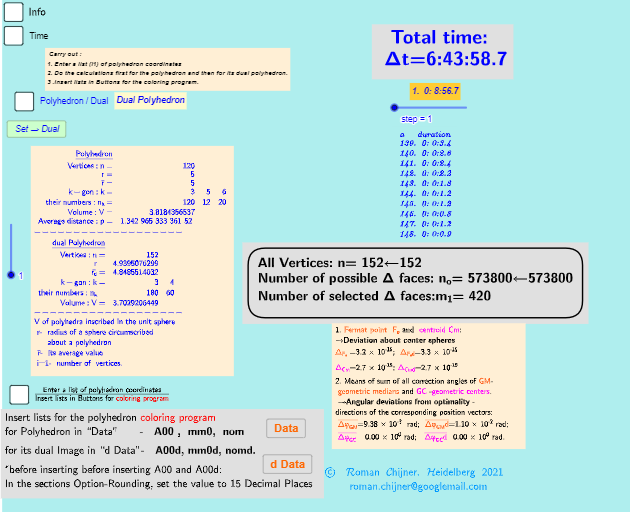
This GeoGebra example demonstrates how to build a specific 3D polyhedron from a biscribed (inner/outer) Pentakis Dodecahedron, using a trisection rule applied to the 6th-order segments. The construction produces a solid with a targeted structural characteristic (notably the reported volume-related value V=120) and supports evaluating volume/measure quantities derived from spherical or normalized relations. Key mathematics includes solid geometry and polyhedral construction, higher-order segmenting (6th-order subdivision), the trisection principle, and measuring geometric quantities using vector/parameter-driven expressions. Construction highlights from the provided command summary: Text and TableText for labeling/outputs, Sequence to generate parameter or segment sets, Div to split/index ranges, Element and IndexOf to retrieve indexed elements from generated sequences, Length for geometric measurements, Sum for aggregating contributions across segments, If for conditional geometry or parameter selection, and Max for choosing extremal/threshold-based parameters. Objects involved include multiple intermediate geometry variables and volume-related quantities such as Volsphere, Vol, Vol_r, Volsphere_d, etc., plus interactive controls like a button. Suitable for advanced high-school through undergraduate learners studying solid geometry, computational geometry, and math visualization with parameterized constructions.
GeoGebra Commands & Parameters
Text("" + p) → txt_pSum(Flatten[Sequence[Append[Sequence[Element[txt_p, i], i, m01(k), m02(k)], " "], k, 1, 5]]) → txtUm1If(bu0, A00, A00d) → A00_0Length(A00_0) → nLength(l2) → läl2Sequence(sgn(Determinant[{Element[A00_0, i1] - Element[A00_0, j], Element[A00_0, i2] - Element[A00_0, j], Element[A00_0, i3] - Element[A00_0, j]}]), j, 1, n) → l01Length(A00d) → zzzSum(Zip[(T * F), T, SysTimeAkt1, F, {1, 1000, 60000, 3600000, 86400000}]) → TimeAbs1Sum(Zip[(T * F), T, SysTimeAkt2, F, {1, 1000, 60000, 3600000, 86400000}]) → TimeAbs2Div(TimeRelab, 3600) → HDiv(TimeRelab - (H * 3600), 60) → MElement(ZwZeit, step) → text10TableText({Append["a duration", Last[ZwZeit, Min[10, Length[ZwZeit]]]]}, "v") → text2cLength(A00) → lm1If(Length[Unique[l01 \ {0}]] ≟ 1, 7, -7) → a7Sum(Zip[(T * F), T, SysTimeAkt0, F, {1, 1000, 60000, 3600000, 86400000}]) → TimeAbs0Div(TimeRelab0, 3600) → H0Div(TimeRelab0 - (H0 * 3600), 60) → M0Text("" + (TimeRelab0 - (H0 * 3600) - (M0 * 60))) → S0aText("" + (TimeRelab - (H * 3600) - (M * 60))) → SIndexOf(".", S) → indexIndexOf(".", S0a) → indexaFirst(S, index + 1) → txtSFirst(S0a, indexa + 1) → txtS0aIf(bu0, " ", "d") → txtbuoMax(Length[A00], Length[A00d]) → maxläElement(A00, 24) → m11TableText({{"\underline{Polyhedron}"}, Append["Vertices: n=", {Length[A00]}], Append["r=", {r}], Append["\bar{r}=", {r_m}], Append["k-gon : k=", mm5a], Append["their\; numbers: n_k=", mm7a], Append["Volume: V=", {Vol_r}], Append["Average\; distance: p=", {txtUm1}]}, "hr ") → text7TableText({{"\underline{dual\;Polyhedron}"}, Append["Vertices: n=", {Length[A00d]}], Append["r=", {r_d}], Append[" \bar{r_d}= ", {r_md}], Append["k-gon : k=", mm5ad], Append["their\; numbers: n_k=", mm7ad], Append["Volume: V=", {Vold_r}]}, "hr ") → text20
AI Drawing Prompt Reference
Construct a trisection-based polyhedron derived from a biscribed pentakis dodecahedron, featuring 120 vertices. Starting from the inner and outer pentakis dodecahedra, apply a trisection rule to the sixth-order segments to generate new vertices and faces. Compute and display geometric quantities for both the polyhedron and its dual, including vertex count, radii, average distances, face types and counts, and volume. Present results in tables and text labels, and include an interactive button to toggle between the original and dual forms.
The prompt above was compiled from the original drawing commands and is for reference only.