
Truncated Dodecahedron: Dependence of Vertex Average Distance on Truncation Para
Loading the math board and drawing, please wait…
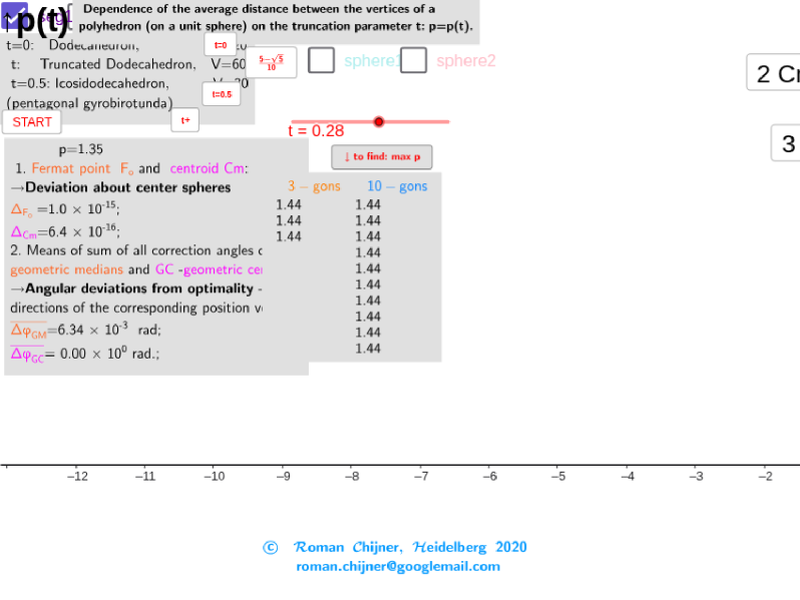
This example demonstrates the geometric phenomenon of how the average distance between vertices of a truncated dodecahedron varies with the truncation parameter. Key mathematical concepts include polygons, solid geometry, optimization, and integral calculus. The construction utilizes GeoGebra commands and objects such as Join, Unique, Length, Text, Sum, Sphere, Ray, Zip, UnicodeToLetter, and TableText as outlined in the construction summary. It is suitable for high school and above students to visually understand parametric geometry and optimization problems.
GeoGebra Commands & Parameters
Join(Zip[lP0(x(a)) + ((lP0(y(a)) - lP0(x(a))) * {t, 1 - t}), a, segN]) → lVVUnique(lVV) → lP'Length(lP') → nLength(lVV(1)) → R2Text("" + p3) → txt_pSum(Flatten[Sequence[Append[Sequence[Element[txt_p, i], i, m1(k), m2(k)], " "], k, 1, 5]]) → txtUm1Sphere(O, R1) → sp1Ray(B, AA) → hZip(Segment[lP0(x(a)), lP0(y(a))], a, segN1) → seg1Zip(Segment[lP0(x(a)), lP0(y(a))], a, segN2) → seg2Text(text12, C, false, true) → text8Zip(Polygon[a], a, v_poly03) → poly03Zip(Polygon[a], a, v_poly10) → poly10UnicodeToLetter(34) → u34Zip(Segment[lVV(x(a)), lVV(y(a))], a, segNΔ3) → segΔ3Zip(Segment[lVV(x(a)), lVV(y(a))], a, segNΔ10) → segΔ10TableText(Append["\;\;\; \fgcolor{#FF7E00}{3-gons}", segΔ3], Append["\;\;\; \fgcolor{#007FFF}{10-gons}", segΔ10], "v") → text3aSphere(O, R2) → sp2
AI Drawing Prompt Reference
Visualize a truncated dodecahedron to demonstrate how the average distance between its vertices varies with the truncation parameter. Construct the vertices and edges of the truncated dodecahedron, calculate the average vertex distance, and highlight the triangular and decagonal faces in different colors. Draw two concentric spheres centered at the origin, one representing the initial radius and the other changing with the truncation parameter. Add text annotations and legends to explain the geometric concepts and optimization involved.
The prompt above was compiled from the original drawing commands and is for reference only.