
Longest Diagonal in a Box (Pythagorean 3D)
Loading the math board and drawing, please wait…
In collections
Geo&Alg:Area Volume Pythagorean Th.
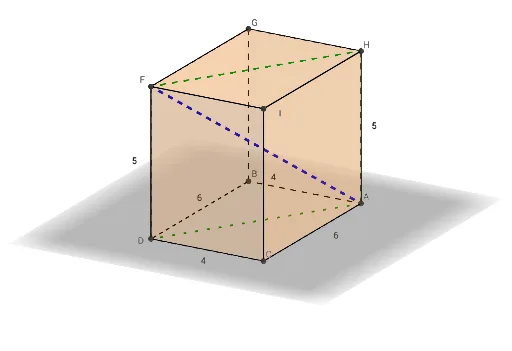
This example demonstrates how to compute the space diagonal of a rectangular prism (box) using the 3D Pythagorean theorem. The core mathematical concept is the distance formula in three dimensions: the diagonal length equals the square root of the sum of squares of the box's length, width, and height, extending the 2D Pythagorean theorem to 3D. Construction highlights: using GeoGebra commands such as Polygon to draw the base rectangle, Prism to create the box, Segment to construct the diagonal and edges, and Text to display the numerical relationships between edge lengths and the diagonal. Through interactive visualization, students can directly observe the geometric connections among the space diagonal, face diagonals, and edges. Suitable for upper secondary or early university students learning solid geometry, this example helps understand distance calculation in 3D space and the generalization of the Pythagorean theorem.
GeoGebra Commands & Parameters
Polygon(D, B, A, C) → poly1, d, b, a, cPrism(poly1, F) → e, G, edgeBG, edgeAH, edgeCI, edgeFG, edgeGH, edgeHI, edgeFI, H, I, faceBDFG, faceABGH, faceACIH, faceCDFI, faceFGHI, edgeDFSegment(F, A) → fSegment(D, A) → gSegment(F, H) → iText(g) → text1Text(f) → text2