
Explore Rotation
Loading the math board and drawing, please wait…
In collections
Geometry Transformation
Maths for 8th Grade Units 1 to 3
Learn with Lindy: Transformations Intro
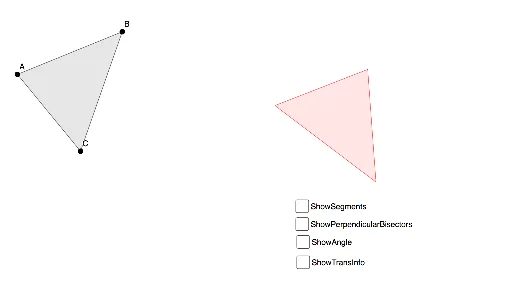
This example demonstrates how to explore the properties of geometric shapes through rotation transformations. Key mathematical concepts include rotation, angles, and polygons. Using GeoGebra commands such as Polygon, Rotate, and Segment, you can construct the rotated shapes. Suitable for students at the junior high school level and above for learning geometric transformations.
GeoGebra Commands & Parameters
Polygon(A, B, C) → poly1, c, a, bRotate(A, (-α), RotPt) → A'Rotate(B, (-α), RotPt) → B'Rotate(C, (-α), RotPt) → C'Polygon(A', B', C') → Rotation, c', a', b'Segment(A, A') → fSegment(B, B') → gSegment(C, C') → hLineBisector(g) → iLineBisector(f) → jLineBisector(h) → kMidpoint(h) → DMidpoint(f) → EMidpoint(g) → FAngle(C, RotPt, C') → γAngle(C', RotPt, C) → δSegment(C, RotPt) → mSegment(C', RotPt) → n
AI Drawing Prompt Reference
Draw a triangle ABC, then rotate it around a point to form a new triangle A'B'C'. Draw line segments between A and A', B and B', C and C'. Find the perpendicular bisectors of these line segments and determine their midpoints D, E, and F. Measure the angles between C and the rotation center, and between C' and the rotation center, which are γ and δ respectively. Finally, draw the line segments from C to the rotation center and from C' to the rotation center.
The prompt above was compiled from the original drawing commands and is for reference only.