
Truncated Cube Construction
Loading the math board and drawing, please wait…
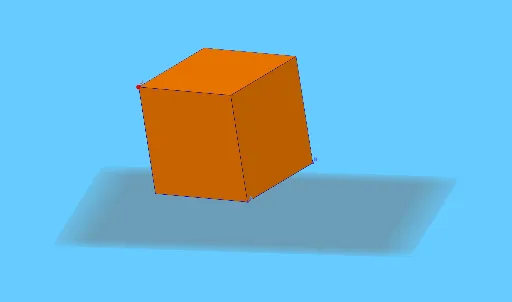
This example demonstrates the geometric construction and properties of a truncated cube. It involves core concepts like solid geometry, polygons, distance calculations, and transformations (rotation, reflection). GeoGebra commands used include Point, Cube, Segment, OrthogonalPlane, IntersectPath, OrthogonalLine, Rotate, Mirror, Polygon, and Distance. Suitable for high school and above students learning solid geometry, geometric construction, and spatial reasoning.
GeoGebra Commands & Parameters
Point(Circle[B, Distance[A, B], Segment[A, B]]) → CCube(A, B, C) → a, D, faceCDHG, faceEFGH, edgeAD, edgeAB, edgeBC, edgeCD, edgeAE, edgeDH, edgeEH, edgeEF, E, edgeBF, edgeFG, edgeCG, edgeGH, F, G, H, faceABCD, faceADHE, faceABFE, faceBCGFTool1(E, H, C, G) → b, ISegment(H, I) → fPoint(f) → JOrthogonalPlane(J, f) → cIntersectPath(c, a) → poly1, K, k, l, m, L, M, T, U, V, g, h, iOrthogonalLine(I, faceABCD) → jRotate(poly1, 90°, j) → poly1'Rotate(poly1, 180°, j) → poly1'_1Rotate(poly1, 270°, j) → poly1'_2Mirror(M, j) → M'Mirror(L, j) → L'Mirror(K, j) → K'Rotate(L, 90°, j) → L'_1Rotate(M, 90°, j) → M'_1Rotate(K, 90°, j) → K'_1Mirror(M'_1, j) → NMirror(K'_1, j) → OMirror(L'_1, j) → POrthogonalPlane(I, j) → dMirror(poly1'_1, d) → t1Mirror(poly1', d) → poly1''Mirror(poly1, d) → poly1'_3Mirror(poly1'_2, d) → t2Mirror(L, d) → L'_2Mirror(K, d) → K'_2Mirror(M, d) → M'_2Mirror(P, d) → P'Mirror(O, d) → O'Mirror(N, d) → N'Mirror(L', d) → L''Mirror(M', d) → M''Mirror(K', d) → K''Mirror(K'_1, d) → QMirror(M'_1, d) → RMirror(L'_1, d) → SPolygon(L, M'_1, K'_1, Q, R, L'_2, K'_2, K) → poly2, l_1, m'_1, k'_1, q, r, l'_2, k'_2, k_1Polygon(L'_1, M', K', K'', M'', S, Q, K'_1) → poly3, l'_1, m', k', k'', m'', s, q_1, k'_3Polygon(P, M, K, K'_2, M'_2, P', O', O) → poly4, p, m_1, k_2, k'_4, m'_2, p', o', oPolygon(L', N, O, O', N', L'', K'', K') → poly5, l', n, o_1, o'_1, n', l'', k''_1, k'_5Polygon(L', M', L'_1, M'_1, L, M, P, N) → poly6, l'_3, m'_3, l'_4, m'_4, l_2, m_2, p_1, n_1Polygon(L'', M'', S, R, L'_2, M'_2, P', N') → poly7, l''_1, m''_1, s_1, r_1, l'_5, m'_5, p'_1, n'_1Distance(H, J) → e