
Truchet Labyrinth Diagonals Construction (Part One)
Loading the math board and drawing, please wait…
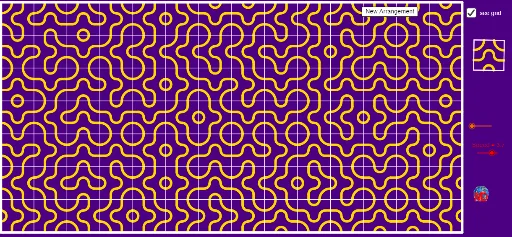
This example demonstrates the dynamic construction of a Truchet labyrinth pattern using diagonal sequences. Core math concepts include geometric constructions, sequences, polygon formation, integral calculus, and logarithmic functions. Key GeoGebra commands used are Sequence, Polygon, Midpoint, Semicircle, Segment, and motif4. Suitable for high school and above, exploring geometric distribution and parametric animations.
GeoGebra Commands & Parameters
Sequence(Sequence[Random[0, 3], k, 1, (2 * n)], j, 1, (2 * n)) → AleaPolygon(G, H, 4) → poly5, e, f, g, h, I, JMidpoint(G, I) → KMidpoint(g) → LSemicircle(G, H) → kSegment(L, K) → imotif4(U, V) → liste4Sequence(Sequence[Rotate[motif4[(k, j), (k + 1, j)], ((Element[Alea, k, j] * 90))°, (k + 1 / 2, j + 1 / 2)], k, 1, (2 * n)], j, 1, n) → liste1Polygon(N, M, F, E) → poly1, n_1, m_1, f_1, e_1Polygon(U, V, 4) → poly2, a, b, c, d, A, BSequence(E + (i, 0), i, 1, (2 * n)) → liste2Sequence(Segment[Element[liste2, i], Element[liste2, i] + (0, n)], i, 1, Length[liste2]) → liste3Sequence(E + (0, i), i, 1, n) → liste5Sequence(Segment[Element[liste5, i], Element[liste5, i] + ((2 * n), 0)], i, 1, Length[liste5]) → liste6