
Trigonometric Composite Transformations and Geometric Mean Demo
Loading the math board and drawing, please wait…
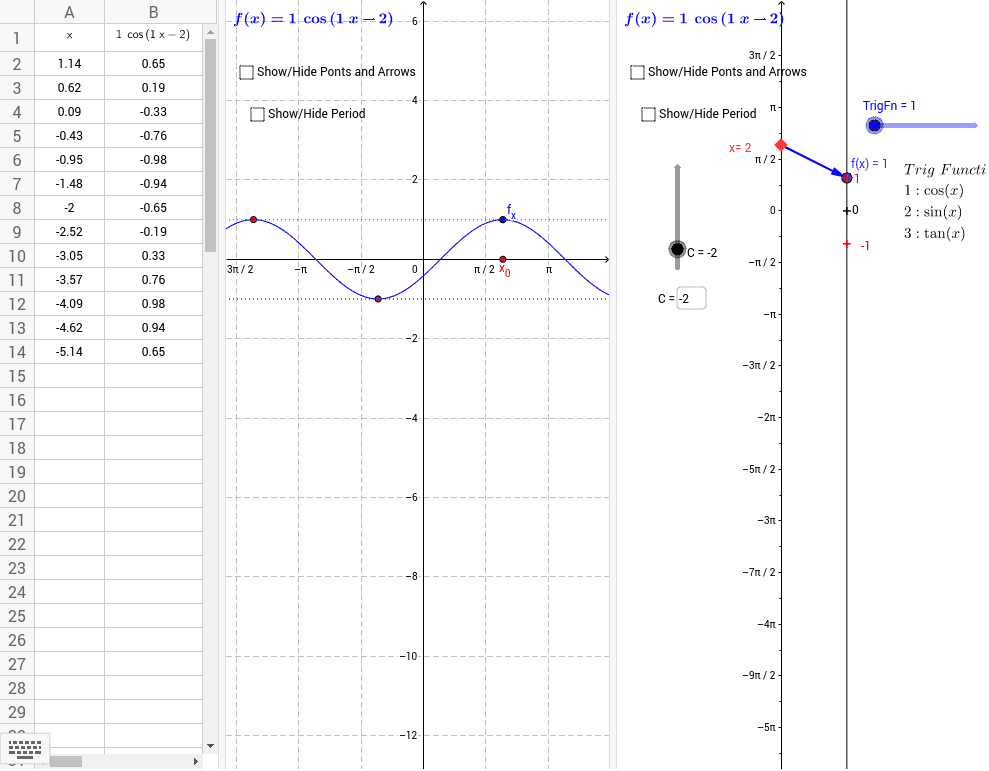
①This GeoGebra example dynamically demonstrates composite transformations of trigonometric functions (e.g., shifts and stretches) and their visual connection to geometric mean, median, and other statistical concepts, supported by histograms and conic sections. ②Core mathematical concepts include trigonometric function transformations, geometric mean, median, conic sections, sequences, and basic derivatives. ③Construction highlights: using commands such as Element, Point, Vector, Segment, Sequence, Textfield, Derivative, and Zip to create objects B, C, TrigFn, k, A, TrigL, f, a_1, a, f_a, u, along with multiple auxiliary points (A1–A14, B1–B7) and function graphs, enabling interactive parameter adjustment via sliders and text inputs. ④Suitable for high school to early college students, ideal for math lab activities or self-exploration, helping to understand geometric meanings of function transformations and statistical measures, and serving as a reference for teachers creating dynamic lessons.
GeoGebra Commands & Parameters
Element(TrigL, TrigFn) → fPoint(yAxis) → aVector(a, f_a) → uSegment(C_1, D) → eVector(E, F) → vSequence((k, f(k)), k, C - π, C + π, 0.5235987755982988) → list1Sequence(Vector[(0, k), (2, f(k))], k, C - π, C + π, 0.5235987755982988) → list2Sequence(Segment[(i, f(i)), ((2 * C) - i, f((2 * C) - i))], i, C - π, C, 0.5235987755982988) → list3Vector(G, H) → wSegment(f_x, J) → jSequence(Segment[(i, f(i)), (π - i, f(π - i))], i, 0, 3.141592653589793, 0.5235987755982988) → suplTextfield(B) → inputBox1Textfield(C) → InputBox1Derivative(f) → f'Vector(f_a, (2, y(f_a) + f'(y(a)))) → hSequence(-5, 5) → nlistZip(((1 / B * ((2 * k) + 1)) * π / 2) - C / B, k, nlist) → xtrslistZip((z, f(z)), z, xtrslist) → xtrsptsZip(((1 / B * k) * π) - C / B, k, nlist) → xrtclistZip((z, f(z)), z, xrtclist) → xtrcptsTextfield(A) → InputBox2Segment(a, Q) → lSegment(a, P) → mVector(P, f_a) → nVector(Q, f_a) → pSegment(f_x, M) → sSegment(f_x, R) → q