
Triangle Exterior Angles and Remote Interior Angles
Loading the math board and drawing, please wait…
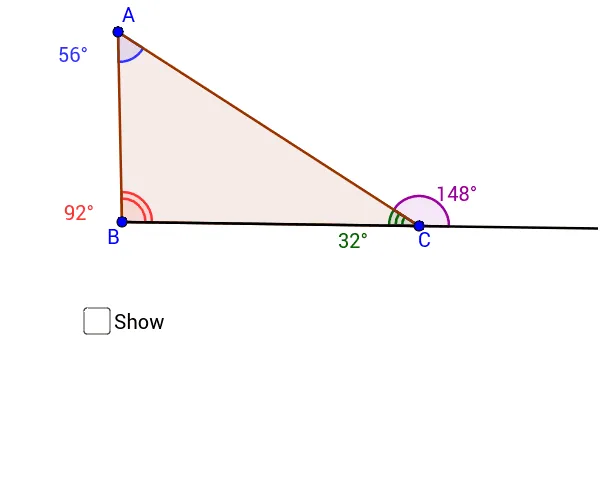
This GeoGebra example demonstrates the geometric relationship between the exterior angle of a triangle and its remote (non-adjacent) interior angles, visually proving that an exterior angle is equal to the sum of the two opposite interior angles. Core mathematical concepts include the triangle angle sum theorem, exterior angle theorem, and basic angle properties. The construction utilizes key GeoGebra commands: `Polygon` to define the triangle `poly1` with vertices `A`, `B`, and `C`; `Ray` to extend the sides and form the exterior angles; and `Angle` to measure and dynamically display the angles α, β, and γ. Text objects like `text1` and `text2` are used to show the algebraic relationship dynamically. This tool is ideal for middle school geometry lessons, interactive classrooms, and student-led investigations on triangle properties.
GeoGebra Commands & Parameters
Polygon(A, B, C) → poly1, h, f, gRay(B, C) → dAngle(B, A, C) → αPoint(d) → DAngle(A, C, D) → α_1Angle(A, B, C) → βAngle(A, C, B) → γ
AI Drawing Prompt Reference
Draw a triangle and extend one of its sides to form an exterior angle, then measure this exterior angle and the two non-adjacent interior angles, dynamically displaying the text that the exterior angle equals the sum of the two interior angles to prove the exterior angle theorem.
The prompt above was compiled from the original drawing commands and is for reference only.