
Triangle Exterior Angle Theorem Dynamic Demonstration
Loading the math board and drawing, please wait…
In collections
Congruence (CO) Cluster
Congruence (Vol 2)
CCSS High School: Geometry (Congruence) Volume 2
CCSS High School: Geometry (Congruence) Volume 2
CCSS High School: Geometry (Congruence) Volume 2
Geometry (Congruence) Volume 2
CCSS High School: Geometry (Congruence) Volume 2
CCSS High School: Geometry (Congruence) Volume 2
CCSS High School: Geometry (Congruence) Volume 2
CCSS High School: Geometry (Congruence) Volume 2
CCSS High School: Geometry (Congruence) Volume 2
CCSS High School: Geometry (Congruence) Volume 2
Gail LeBlancCCSS High School: Geometry (Congruence) Volume 2
CCSS High School: Geometry (Congruence) Volume 2
CCSS High School: Geometry (Congruence) Volume 2
Triangle Theorems
Unit 7: Polygons and Quadrilaterals
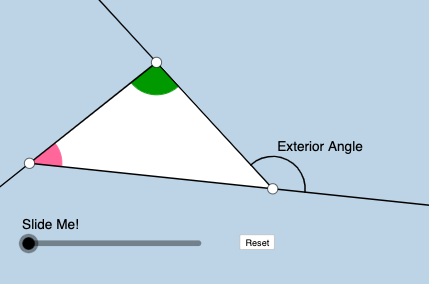
① This GeoGebra example dynamically demonstrates the Triangle Exterior Angle Theorem, showing that an exterior angle of a triangle equals the sum of the two non-adjacent interior angles. ② Core mathematical concepts include exterior angles, interior angles, angle measurement, triangle angle sum, and geometric reasoning. ③ Construction highlights: using GeoGebra commands such as Line, Ray, Segment to build the triangle and its extended sides; Angle to mark and measure angles; Point, Intersect, Polygon for basic objects; and Rotate, Translate, Dilate for dynamic transformations. Sliders or draggable points allow changing the triangle shape to verify the theorem holds universally. ④ Suitable for middle school geometry lessons, high school review, and teacher-created interactive materials, as well as student self-exploration of angle relationships in triangles.
GeoGebra Commands & Parameters
Line(A, B) → fSlope(f) → aPointIn(c) → CSegment(A, C) → gSegment(C, B) → hSegment(B, A) → iMin(list1) → dCircle(A, (0.2 * d)) → eCircle(B, (0.2 * d)) → kCircle(C, (0.2 * d)) → pRay(A, B) → jRay(B, C) → lRay(C, A) → mPoint(j) → DPoint(l) → EPoint(m) → FRay(B, D) → nRay(C, E) → qRay(A, F) → rIntersect(p, g, 1) → GIntersect(p, h, 1) → HIntersect(e, i, 1) → IIntersect(e, g, 1) → JCircleSector(A, I, J) → sCircleSector(C, G, H) → tPolygon(A, B, C) → poly1, c_1, a_1, b_1Dilate(A, If[0 < o ≤ 1, 1 - o, 0], B) → A'Vector(A, A') → uTranslate(s, u) → s'CircleArc(A, I, J) → d_1Distance(A, I) → vRotate(t, If[1 < o ≤ 2, ((o - 1) * pi), pi], C) → t'CircleArc(C, G, H) → e_1Angle(G, C, H) → αDilate(C, If[2 < o ≤ 3, 3 - o, 0], B) → C'Vector(C, C') → u_1Translate(t', u_1) → t''Intersect(k, n) → K,Intersect(k, h) → L,CircleArc(B, K, L) → f_1