
Your Test for Similarity #1
Loading the math board and drawing, please wait…
In collections
Tests for Similarity
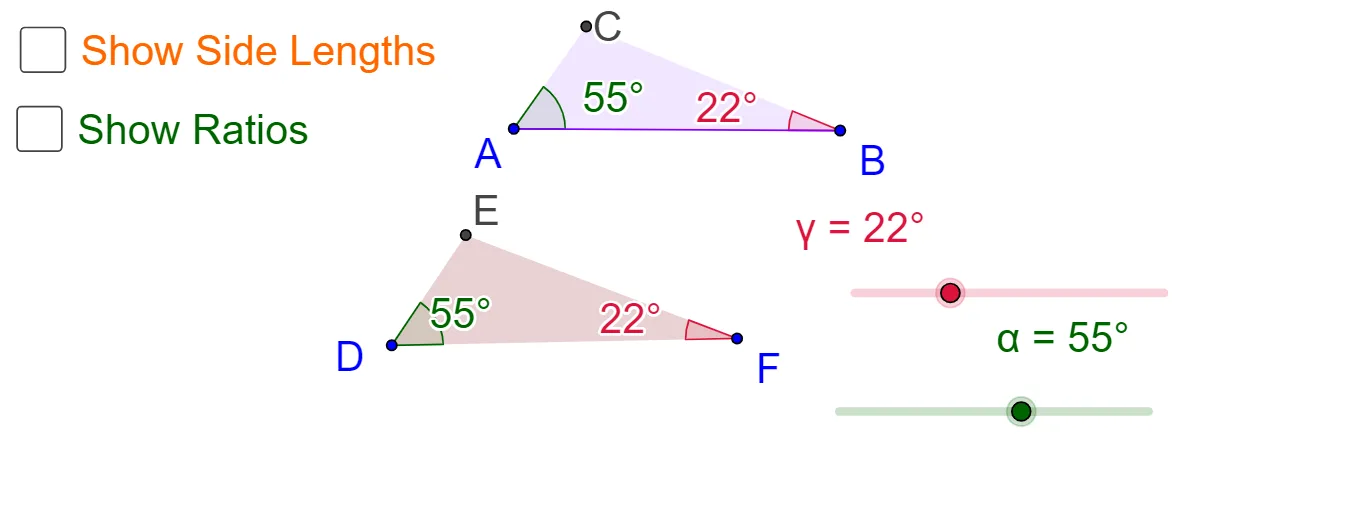
① This applet demonstrates why the AA (Angle-Angle) similarity criterion is valid for triangles, showing that if two angles of one triangle are equal to two angles of another, the triangles are similar and their corresponding sides are proportional. ② The core mathematical concept is triangle similarity, specifically the AA postulate, involving angle equality and side ratios. ③ Construction details: using GeoGebra commands such as Segment, Rotate, Angle, Line, Intersect, Polygon, and Distance, the applet constructs two triangles with labeled angles (α, β, γ, etc.) and measures distances (e.g., distanceAC, distanceCB, distanceBA) to verify proportional sides. ④ Suitable for middle school geometry classes or high school review, this interactive tool helps students grasp the AA similarity condition and can be used for classroom demonstration or independent exploration.
GeoGebra Commands & Parameters
Segment(A, B) → aRotate(B, α, A) → B'Angle(B, A, B') → βRotate(A, (-γ), B) → A'Angle(A', B, A) → δLine(A', B) → bLine(A, B') → cIntersect(b, c) → CPolygon(C, A, B) → poly1, b_1, c_1, a_1Segment(D, F) → a_3Rotate(F, α, D) → B'_1Angle(F, D, B'_1) → β_1Rotate(D, (-γ), F) → A'_1Angle(A'_1, F, D) → δ_1Line(A'_1, F) → b_3Line(D, B'_1) → c_3Intersect(b_3, c_3) → EPolygon(E, D, F) → poly1_1, b_2, c_2, a_2Angle(E, F, D) → εAngle(F, D, E) → ζDistance(A, C) → distanceACDistance(C, B) → distanceCBDistance(B, A) → distanceBADistance(E, D) → distanceEDDistance(D, F) → distanceDFDistance(F, E) → distanceFE
AI Drawing Prompt Reference
Construct two triangles with different base lengths but identical angle settings. For each triangle, start with a base segment, rotate one endpoint by a given angle to create a ray, rotate the other endpoint by the negative of another angle to create a second ray, and mark the intersection as the third vertex. Label all interior angles. Then measure and display the lengths of all three sides for both triangles to show that equal corresponding angles lead to proportional side lengths.
The prompt above was compiled from the original drawing commands and is for reference only.