
Similarity Test #3: Dynamic Geometry Exploration of Rotation and Proportionality
Loading the math board and drawing, please wait…
In collections
Tests for Similarity
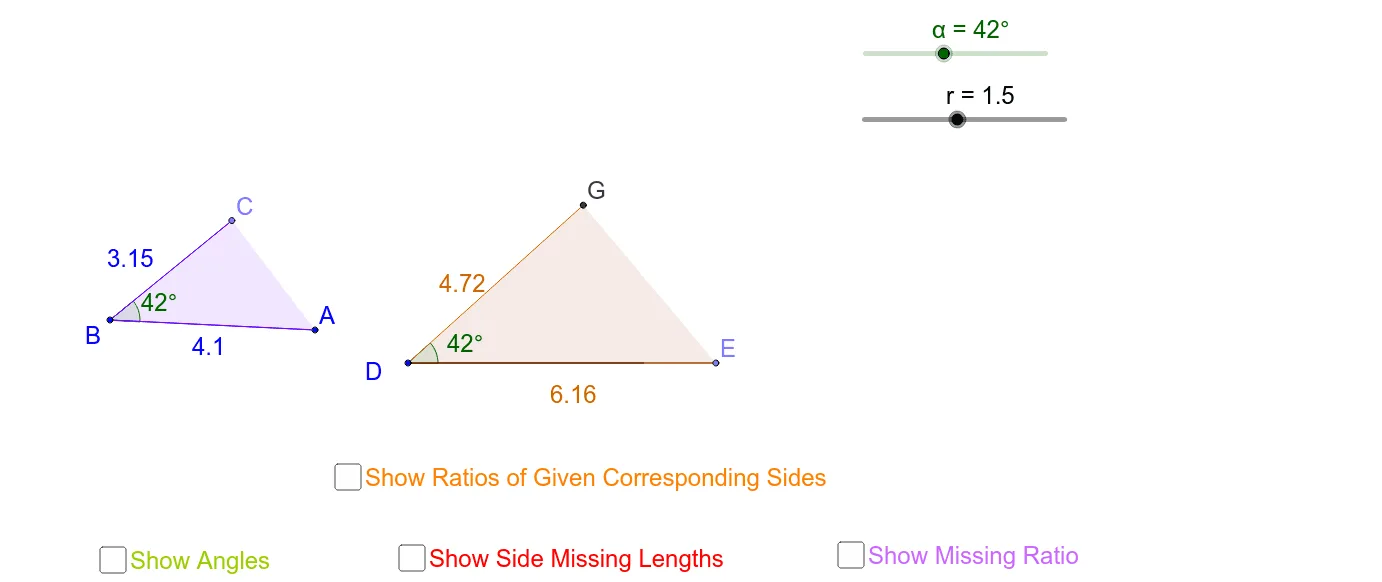
① This example demonstrates how to test whether two polygons (poly1 and poly2) are similar using rotation, angle, and proportional relationships, visually showing the similarity transformation. ② Core mathematical concepts include similarity, rotation, corresponding angles, proportional sides, and optimization ideas from linear programming (e.g., constraints on angles or lengths). ③ Construction highlights: from the summary, GeoGebra commands such as Rotate, Angle, Line, Point, Segment, Polygon, Circle, and Intersect are used, creating multiple auxiliary objects (angles α, β, γ; segments a, b, c) and generating rotated points A', E' to form the two polygons, with text objects (text1, text2, text3) displaying measurements. ④ Suitable for middle/high school geometry or math lab courses, helping students understand similarity criteria and serving as a dynamic demonstration for teachers, also touching on cosine theorem and linear programming applications.
GeoGebra Commands & Parameters
Rotate(A, α, B) → A'Angle(A, B, A') → βLine(A', B) → aLine(B, A) → bPoint(a) → CSegment(B, C) → dSegment(B, A) → ePolygon(C, B, A) → poly1, a_1, c_1, b_1Point(Circle[D, abs(q)]) → ESegment(D, E) → cRotate(E, α, D) → E'Angle(E, D, E') → γLine(D, E') → fPoint(Circle[D, abs(p)]) → FSegment(D, F) → gCircle(D, F) → hIntersect(h, f, 2) → GPolygon(G, D, E) → poly2, e_1, g_1, d_1Angle(B, C, A) → δAngle(D, G, E) → εAngle(G, E, D) → ζAngle(C, A, B) → η
AI Drawing Prompt Reference
Draw two polygons showing similarity through rotation, with one polygon rotated to align its vertices with the other. Use auxiliary lines and circles to find key points, label corresponding angles and sides, display their proportional relationships and rotation angle, and include text annotations for measurements to illustrate the similarity transformation.
The prompt above was compiled from the original drawing commands and is for reference only.