
Triangle Congruence Demo by Mr. Krebs
Loading the math board and drawing, please wait…
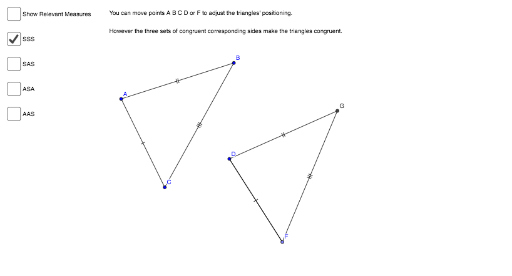
This example demonstrates the criteria and properties of triangle congruence. It involves core mathematical concepts such as congruence, geometric transformations, reflection, angles, and ratios. The construction uses commands like Polygon, Circle, Point, Segment, Intersect, Angle, Rotate, and Ray in GeoGebra to illustrate congruence relationships through rotation and reflection. Suitable for high school mathematics education to understand congruence theorems and practical constructions.
GeoGebra Commands & Parameters
Polygon(A, B, C) → poly1, c, a, bCircle(A, B) → dCircle(C, B) → eCircle(D, c) → fPoint(Circle[D, abs(b)]) → FSegment(D, F) → gCircle(F, a) → hIntersect(h, f) → E_1, G, ,Polygon(D, F, G) → poly2, g_1, d_1, f_1Segment(A, C) → iSegment(D, F) → jSegment(A, B) → kSegment(D, G) → lSegment(C, B) → mSegment(F, G) → nSegment(H, I) → pSegment(H, J) → qAngle(I, H, J) → αSegment(J, I) → rPoint(Circle[K, abs(q)]) → LSegment(K, L) → sRotate(K, (-α), L) → K'Angle(K', L, K) → βRay(L, K') → tCircle(L, p) → c_1Intersect(c_1, t) → M,Segment(M, K) → a_1Segment(L, M) → b_1Segment(N, O) → e_1Segment(P, N) → h_1Segment(P, O) → i_1Angle(O, N, P) → γAngle(P, O, N) → δPoint(Circle[Q, abs(e_1)]) → RSegment(Q, R) → j_1Rotate(R, γ, Q) → R'Angle(R, Q, R') → εRotate(Q, (-δ), R) → Q'Angle(Q', R, Q) → ζRay(Q, R') → k_1Ray(R, Q') → l_1Intersect(k_1, l_1) → SSegment(S, Q) → m_1Segment(S, R) → n_1Segment(T, U) → p_1Segment(U, V) → q_1Segment(V, T) → r_1Point(Circle[W, abs(p_1)]) → ZSegment(W, Z) → t_1Angle(T, U, V) → ηAngle(U, V, T) → θRotate(W, η, Z) → W'Angle(W, Z, W') → ιAngle(V, T, U) → κRotate(Z, (-κ), W) → Z'Angle(Z', W, Z) → λRay(Z, W') → a_2Ray(W, Z') → b_2Intersect(b_2, a_2) → ESegment(W, E) → c_2Segment(E, Z) → d_2Angle(Z, E, W) → μSegment(A, B) → e_2Segment(A, C) → f_2Segment(C, B) → h_2Segment(G, D) → i_2Segment(D, F) → j_2Segment(G, F) → k_2Segment(K, L) → l_2Segment(L, M) → m_2Segment(J, H) → n_2Segment(H, I) → p_2Angle(M, L, K) → νAngle(I, H, J) → ξSegment(N, O) → q_2Segment(Q, R) → r_2Angle(O, N, P) → οAngle(R, Q, S) → ρAngle(P, O, N) → σAngle(S, R, Q) → τSegment(U, T) → s_2Segment(Z, W) → t_2Angle(T, U, V) → υAngle(W, Z, E) → ϕAngle(U, V, T) → χAngle(Z, E, W) → ψ