
Congruence Postulates
Loading the math board and drawing, please wait…
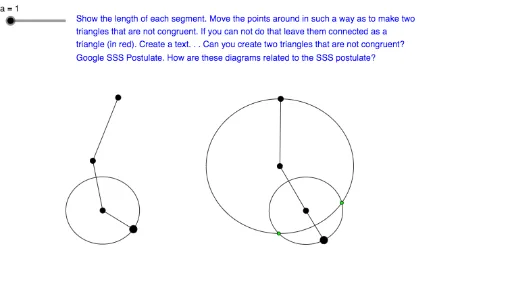
This example demonstrates the postulates of congruent triangles, involving key mathematical concepts such as the definition and methods of determining congruent triangles. Using GeoGebra commands like Point, Segment, Circle, Angle, etc., congruent triangles can be constructed. Suitable for middle and high school students to learn about geometric construction and congruent triangles.
GeoGebra Commands & Parameters
Point(Circle[A, 2]) → BSegment(A, B) → fPoint(Circle[B, 3]) → CSegment(B, C) → gPoint(Circle[C, 4]) → DSegment(C, D) → hPoint(Circle[A_1, 2]) → B_1Segment(A_1, B_1) → f_1Point(Circle[B_1, 3]) → C_1Segment(B_1, C_1) → g_1Point(Circle[C_1, 4]) → D_1Segment(C_1, D_1) → h_1Circle(B, A) → cCircle(C_1, D_1) → dPoint(Circle[E, 2]) → FSegment(E, F) → tPoint(Circle[G, t]) → HSegment(G, H) → i_1Point(Circle[F, 5]) → ISegment(F, I) → j_1Point(Circle[H, 5]) → JSegment(H, J) → k_1Angle(I, F, E) → αRotate(G, α, H) → G'Ray(H, G') → l_1Angle(J, H, G) → βPoint(Circle[K, 8]) → LSegment(K, L) → m_1Point(Circle[L, 5]) → MSegment(L, M) → n_1Ray(M, N) → p_1Ray(L, K) → q_1Intersect(p_1, q_1) → OSegment(M, O) → r_1Segment(N, M) → s_1Angle(N, M, L) → εPoint(Circle[K_1, 8]) → L_1Segment(K_1, L_1) → m_2Point(Circle[L_1, 5]) → M_1Segment(L_1, M_1) → n_2Ray(M_1, N_1) → p_2Ray(L_1, K_1) → q_2Segment(N_1, M_1) → s_2Angle(N_1, M_1, L_1) → ε_1Angle(L_1, M_1, N_1) → ζRay(L_1, K_1) → t_1Intersect(t_1, s_2) → PSegment(P, M_1) → c_1Circle(B_1, A_1) → c_2Intersect(d, c_2) → S, T, ,Rotate(J, α, H) → J'Angle(J, H, J') → ιRotate(G, α, H) → G'_1Angle(G, H, G'_1) → κSegment(H, J') → f_2Circle(H, G) → e_2Intersect(e_2, f_2) → Q,Ray(H, G'_1) → g_2Circle(H, J) → h_2Intersect(h_2, g_2) → R,Ray(M_1, K_1) → i_2Circle(M_1, N_1) → k_2Rotate(L_1, ε, M_1) → UAngle(L_1, M_1, U) → λRay(M_1, U) → j_2Intersect(k_2, j_2) → V,Rotate(K_1, (-ε), M_1) → WAngle(W, M_1, K_1) → μCircle(M_1, L_1) → r_2Ray(M_1, W) → l_2Intersect(r_2, l_2) → Z,