
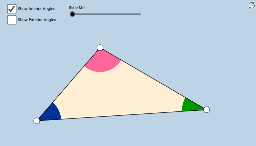
Triangle Angle Sum Theorem Demo by Tim Brzezinski
Loading the math board and drawing, please wait…
In collections
Congruence (CO) Cluster
Congruence (Vol 2)
CCSS High School: Geometry (Congruence) Volume 2
CCSS High School: Geometry (Congruence) Volume 2
CCSS High School: Geometry (Congruence) Volume 2
Geometry (Congruence) Volume 2
CCSS High School: Geometry (Congruence) Volume 2
CCSS High School: Geometry (Congruence) Volume 2
CCSS High School: Geometry (Congruence) Volume 2
CCSS High School: Geometry (Congruence) Volume 2
CCSS High School: Geometry (Congruence) Volume 2
CCSS High School: Geometry (Congruence) Volume 2
Gail LeBlancCCSS High School: Geometry (Congruence) Volume 2
CCSS High School: Geometry (Congruence) Volume 2
CCSS High School: Geometry (Congruence) Volume 2
Triangle Theorems
Unit 7: Polygons and Quadrilaterals
Polygons & Angles
Polygons & Angles
Polygons & Angles ( s n attar)
Unit 5: Triangle Congruence
Parallel Lines and Planes
Polygons & Angles
Polygons & Angles
Polygons & Angles
Geometry: Polygons & Angles
Polygons & Angles
This example uses transformational geometry tools to demonstrate the Triangle Angle Sum Theorem, involving core concepts like triangle interior angles and geometric transformations. It constructs a triangle and shows its sum is 180 degrees using commands like Segment, Polygon, Angle, Rotate, and Vector, suitable for middle school and above learning geometric proofs and transformations.
GeoGebra Commands & Parameters
Segment(B, C) → eSegment(C, A) → fMin(f, e) → mSegment(A, B) → dMin(d, f) → oMin(m, o) → uPolygon(A, B, C) → poly1, c, a, bRay(A, B) → hRay(B, C) → iRay(C, A) → jCircle(C, (0.25 * u)) → pCircle(A, (0.25 * u)) → qCircle(B, (0.25 * u)) → rIntersect(p, f) → D,Intersect(p, e, 1) → EIntersect(r, e, 1) → FIntersect(r, d, 1) → GIntersect(q, d, 1) → HIntersect(q, f, 1) → IIntersect(r, h, 2) → JIntersect(q, j, 2) → KIntersect(p, i, 2) → LMidpoint(f) → MMidpoint(e) → NCircleSector(A, H, I) → sCircleSector(B, F, G) → tCircleSector(C, D, E) → c_1Angle(A, C, B) → αCircleSector(C, E, D) → d_1CircleSector(A, I, H) → e_1CircleSector(B, G, F) → f_1Min(d, e) → nRotate(s, If[0 < l ≤ 1, (((-l) * 180))°, -180°], M) → s'Rotate(A, If[0 < l ≤ 1, (((-l) * 180))°, -180°], M) → A'Segment(M, A') → a_1Rotate(H, -180°, M) → H'Line(H', C) → b_1Rotate(B, If[0 < l ≤ 1, ((l * 180))°, 180°], N) → B'Rotate(t, If[0 < l ≤ 1, ((l * 180))°, 180°], N) → t'Segment(N, B') → g_1Segment(C, M) → h_1Segment(M, A) → i_1Segment(C, N) → j_1Segment(N, B) → k_1Rotate(A, If[0 < l ≤ 1, ((l * 180))°, -180°], M) → A'_1Rotate(B, If[0 < l ≤ 1, (((-l) * 180))°, -180°], N) → B'_1Segment(N, B'_1) → l_1Segment(M, A'_1) → m_1Rotate(e_1, If[0 < l ≤ 1, ((l * 180))°, -180°], M) → p_1Rotate(f_1, If[0 < l ≤ 1, (((-l) * 180))°, -180°], N) → q_1CircleSector(C, L, D) → r_1CircleSector(A, K, H) → s_1CircleSector(B, J, F) → t_1CircleSector(A, H, K) → c_2CircleSector(B, F, J) → d_2CircleSector(C, D, L) → e_2Dilate(A, 1 - v, C) → A'_2Dilate(B, 1 - v, C) → B'_2Vector(A, A'_2) → wVector(B, B'_2) → u_1Translate(s_1, w) → f_2CircleArc(A, K, H) → g_2Translate(t_1, u_1) → h_2CircleArc(B, J, F) → k_2Translate(c_2, w) → p_2CircleArc(A, H, K) → q_2Translate(d_2, u_1) → r_2CircleArc(B, F, J) → s_2
AI Drawing Prompt Reference
Draw a triangle and demonstrate that the sum of its interior angles is 180 degrees. Start by constructing the triangle's three sides, then draw perpendiculars from each vertex to the opposite side, forming a new triangle with the intersections. Next, draw circles centered at the vertices and the feet of the perpendiculars, connecting the intersections to create additional shapes. Finally, use rotations and line segments to show the translation and combination of the angles, proving the theorem.
The prompt above was compiled from the original drawing commands and is for reference only.