
Triangle Angle Sum Property Demo
Loading the math board and drawing, please wait…
In collections
CLASS IX CBSE MATHS ACTIVITIES
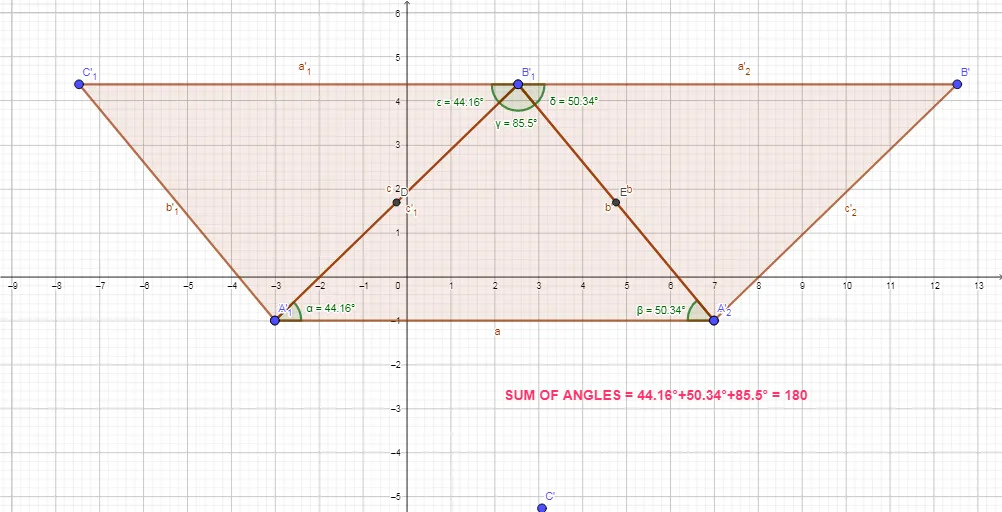
This example dynamically demonstrates the property that the sum of interior angles in a triangle is 180 degrees. It involves core math concepts like triangles, angles, and geometric transformations. Key GeoGebra commands used include Polygon, Angle, Midpoint, Rotate, and Mirror to construct the triangle and auxiliary shapes. Suitable for middle school and above students to learn and understand geometric theorems.
GeoGebra Commands & Parameters
Polygon(A, B, C) → t1, c, a, bAngle(C, B, A) → αAngle(A, C, B) → βAngle(B, A, C) → γMidpoint(B, A) → DMidpoint(A, C) → ERotate(C, (-α), D) → C'Mirror(A, D) → A'_1Mirror(B, D) → B'_1Mirror(C, D) → C'_1Polygon(A'_1, B'_1, C'_1) → t1', c'_1, a'_1, b'_1Mirror(A, E) → A'_2Mirror(B, E) → B'Mirror(C, E) → C'_2Polygon(A'_2, B', C'_2) → t1'_1, c'_2, a'_2, b'Angle(C, A, B') → δAngle(C'_1, A, B) → ε
AI Drawing Prompt Reference
Draw a triangle with vertices A, B, and C and label its three interior angles at A, B, and C to illustrate the triangle interior-angle sum property. Then mark the midpoints of AB and AC as D and E. Rotate point C about D by an amount corresponding to the angle at B (using the angle value α) to obtain C'. Reflect A, B, and C across the lines through D associated with AD, BD, and CD to create the mirror triangle A'_1B'_1C'_1. Next, reflect A, B, and C across point E to form a second mirror triangle A'_2BC'_2. Finally, add related angle markings (such as δ and ε) formed by the relevant point pairs around C and C'_1 to show how angles change under rotation and reflection.
The prompt above was compiled from the original drawing commands and is for reference only.