
Trapezoidal Rule
Loading the math board and drawing, please wait…
In collections
SCIE1000
This example demonstrates the trapezoidal rule, a numerical integration method. It approximates the definite integral by dividing the function graph into multiple trapezoids. Key mathematical concepts include functions, integration, and numerical methods. Commands used include If, Sequence, Max, Min, Textfield, Vector, OrthogonalLine, Sum, and TrapezoidalSum. Suitable for high school math education and learning calculus.
GeoGebra Commands & Parameters
If(a1 ≥ 0, 0.8, 1.1) → View1xIf(a1 ≟ 0, -0.2, a1) → cond2xIf(a ≤ 0, 0.8, 1.1) → View2yIf(a ≟ 0, 0.2, a) → cond2ySequence(g(i), i, a1, a, 0.1) → list1Max(list1) → maxlist1Min(list1) → minlist1Textfield(f) → InputBox1Vector(A, B) → uVector(A, C) → vOrthogonalLine(C, yAxis) → hOrthogonalLine(B, yAxis) → iIf(y(v) > 0, 0, 1) → condyIf(y(u) < 0, 0, 1) → condxIf(ymin ≟ 0, (ymax * (-0.1)), ymin) → condy2If(ymax ≟ 0, (ymin * (-0.1)), ymax) → condx2Textfield(a) → InputBox2Sequence(a1 + ((k - 1 + d) * dx), k, 1, n) → list2Sequence((f(Element[list2, i]) * dx), i, 1, n) → list4Sum(list4) → RiemannSumIf(d ≟ 1, "R", If[d ≟ 0.5, "M", "L"]) → text3Textfield(n) → InputBox3Textfield(a1) → InputBox4Sequence(Polygon[(a1 + ((k - 1) * dx), 0), (a1 + (k * dx), 0), (a1 + (k * dx), f(Element[list2, k])), (a1 + ((k - 1) * dx), f(Element[list2, k]))], k, 1, n) → list3TrapezoidalSum(f, a1, a, n) → j
AI Drawing Prompt Reference
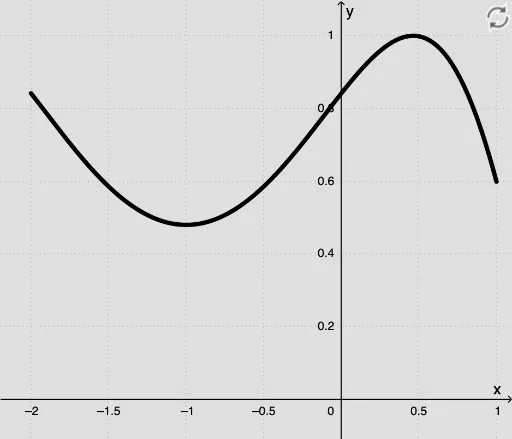
Draw the trapezoidal approximation of the integral of a function f(x) over the interval [a1, a]. Start by setting the x-axis starting point based on a1, then plot the function graph, divide it into multiple trapezoids, calculate the area of each trapezoid, and sum them up to show the total area.
The prompt above was compiled from the original drawing commands and is for reference only.