
Trapezium Folding Demonstration
Loading the math board and drawing, please wait…
In collections
Folding paper, doing geometry figures
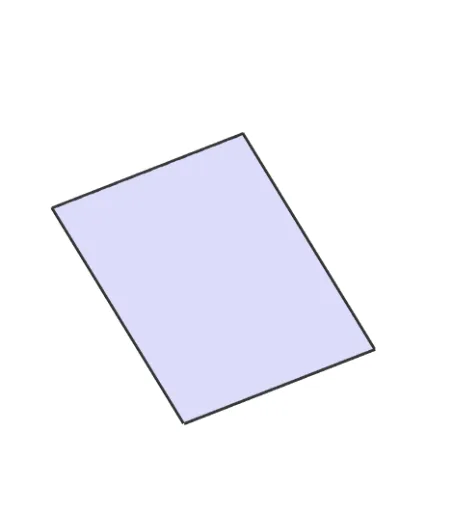
This example demonstrates the geometric transformation and properties of a trapezium after folding. It involves core math concepts like polygons, geometric transformations (rotation), midpoints, line segments, and circle arcs. Construction highlights include commands such as Polygon, Midpoint, CircleArc, Segment, Rotate, Intersect, OrthogonalLine, Line, and Point. Suitable for high school geometry teaching to understand trapezium properties and transformation relationships.
GeoGebra Commands & Parameters
Polygon(A, C, D, B) → vierhoek1, a, c, d, bMidpoint(B, D) → BDMidpoint(A, C) → FMidpoint(B, E) → GCircleArc(B, DD, D) → eSegment(B, E) → fPolygon(B, A, C, E) → vierhoek2, b_1, a_1, c_1, e_1Polygon(B, E, D) → driehoek1, d_1, b_2, e_2Rotate(B, (((-(s - 1)) * 180))°, e_1) → B'Rotate(E, (((-(s - 1)) * 180))°, e_1) → E'Rotate(D, (((-(s - 1)) * 180))°, e_1) → D'Polygon(B', E', D') → driehoek1', d', b', e'Polygon(DD, E, B) → driehoek2, b_3, dd, e_3Segment(G, F) → gPolygon(G, F, C, E) → vierhoek3, g_1, f_1, c_2, e_4Polygon(B, A, F, G) → vierhoek4, b_4, a_2, f_2, g_2Rotate(G, (((-(s - 3)) * 180))°, f_2) → G'Rotate(F, (((-(s - 3)) * 180))°, f_2) → F'Rotate(C, (((-(s - 3)) * 180))°, f_2) → C'Rotate(E, (((-(s - 3)) * 180))°, f_2) → E'_1Polygon(G', F', C', E'_1) → vierhoek3', g', f', c', e'_1Polygon(A, F, G, DD) → vierhoek5, a_3, f_3, g_3, dd_1Polygon(FE, A, F) → driehoek3, f_4, fe, a_4Segment(A, FA) → iRotate(FE, (((-(s - 5)) * 180))°, i) → FE'Rotate(A, (((-(s - 5)) * 180))°, i) → A'Rotate(F, (((-(s - 5)) * 180))°, i) → F'_1Polygon(B, A, FA, G) → vierhoek6, r, t, i_1, j_1Intersect(g_3, i) → HOrthogonalLine(H, g', xOyPlane) → jLine(BD, F) → nPoint(n) → KCircleArc(K, C, A) → pPolygon(G, H, F) → driehoek4, f_6, g_5, h_1Intersect(f_6, Line[FE, GG]) → JOrthogonalLine(H, b) → kCircleArc(A, F, FB) → hPolygon(A, F, FA) → driehoek5, fa, a_5, f_5Rotate(A, (((-(s - 5)) * 180))°, t) → A'_1Rotate(F, (((-(s - 5)) * 180))°, t) → F'_2Rotate(FA, (((-(s - 5)) * 180))°, t) → FA'Polygon(A'_1, F'_2, FA') → driehoek5', fa', a'_1, f'_2Line(DD, GG) → lIntersect(l, i) → IPolygon(G, DD, I, FA) → vierhoek7, g_4, dd_2, i_2, fa_1Line(FB, FA) → mIntersect(m, g_4) → MSegment(M, G) → qSegment(DD, I) → k_1Segment(DD, M) → l_1
AI Drawing Prompt Reference
Draw a trapezoid and demonstrate its geometric transformation after folding. Start by constructing the trapezoid, then find the midpoints of the non-parallel sides and connect them to form a new quadrilateral. Next, simulate the folding process using rotation, observing the shape changes and geometric relationships of the trapezoid after folding, including rotation angles, midpoints, line segments, and circular arcs.
The prompt above was compiled from the original drawing commands and is for reference only.