
Transforming Quadratic Function Graphs
Loading the math board and drawing, please wait…
In collections
Quadratic Functions Anatomy and Transformations
Transforming Quadratic Function Graphs
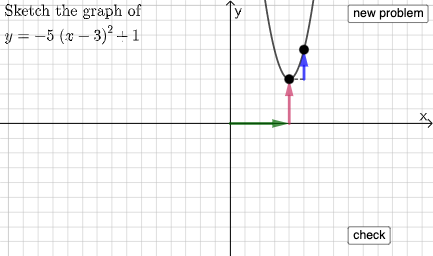
This example demonstrates transformations of quadratic function graphs including translations and scalings. Key math concepts involve quadratic functions, graph transformations, vertex coordinates, and axis of symmetry. GeoGebra commands like Sequence, Union, Point, Line, Vector, Polygon, Segment, RandomElement, Random are used in construction. Suitable for high school mathematics education to understand function transformation rules.
GeoGebra Commands & Parameters
Sequence(i, i, 1, 5, 1) → l2Sequence(i, i, -5, -1, 1) → l1Union(l1, l2) → l3Point(Segment[(h + 1, y(C) + 10), (h + 1, y(C) - 10)]) → DLine(A, B) → fVector(A, C) → uPolygon(A, C, B) → t1, b, a_1, cSegment(A, C) → h_{1}Vector(C, D) → vVector((h, 0), A) → wVector((0, 0), (h, 0)) → jRandomElement(l3) → nRandom(-5, 5) → oRandom(-5, 5) → p
AI Drawing Prompt Reference
Draw a graph with a parabola, a line, and a point. The parabola is centered, the line passes through the vertex, and the point is on the axis of symmetry. Ensure the graph is clear and lines are connected.
The prompt above was compiled from the original drawing commands and is for reference only.