
Transformations of the Natural Logarithm Function
Loading the math board and drawing, please wait…
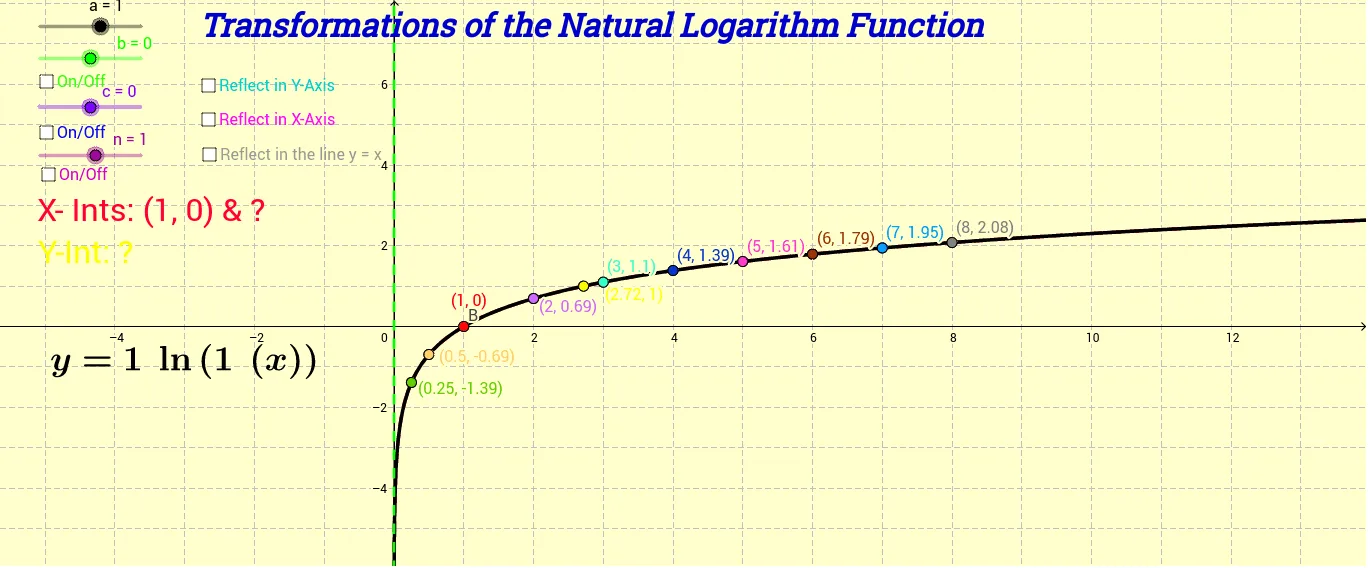
This example demonstrates the transformations of the natural logarithm function y=ln(x) and how its graph changes under various transformations. Key math concepts include function transformations (translations, scalings), graph characteristics, derivatives, and monotonicity. GeoGebra commands like Root, Extremum, Mirror, and Intersect are used, along with objects such as parameters p, n, c, b, a, and dynamic elements. It is suitable for high school and above students to understand the impact of function transformations on graphs and explore properties of the natural logarithm function.
GeoGebra Commands & Parameters
Root((a * c)) → AExtremum((a * (x - b)^(2)) + c) → DMirror(v, x = 0) → v_1Mirror(v, y = 0) → v_2Roots(v, -50, 50) → B, CIntersect(v, x = 0, (0, 0.34657359027997264)) → EMirror(v, k) → v_3
AI Drawing Prompt Reference
Draw the natural logarithm function y=ln(x) and its transformations, including translations and scalings. First, plot the function, then add parameters a and c to translate the function into v. Next, perform mirror transformations of v about the x-axis and y-axis, find the roots and extrema of v, and finally locate the intersection point E of v with the y-axis.
The prompt above was compiled from the original drawing commands and is for reference only.