
Transformations from R² to R²
Loading the math board and drawing, please wait…
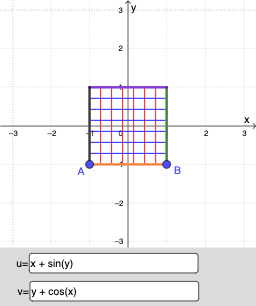
This example demonstrates transformations from a two-dimensional space to another two-dimensional space. It involves concepts such as similarity transformations, functions, and vectors. Using GeoGebra commands like Polygon, Derivative, and Sequence, the effect of transformations can be dynamically observed. Suitable for high school mathematics education and learning.
GeoGebra Commands & Parameters
Polygon(A, B, 4) → square, f, g, h, i, C, DDerivative(u, x) → uxDerivative(u, y) → uyDerivative(v, x) → vxDerivative(v, y) → vySequence(Segment[A + (i * (B - A) / n), D + (i * (C - D) / n)], i, 0, n) → verticalSequence(Segment[A + (i * (D - A) / n), B + (i * (C - B) / n)], i, 0, n) → horizontalPoint(Element[vertical, 1]) → A1Point(Element[vertical, 2]) → A2Point(Element[vertical, 3]) → A3Point(Element[vertical, 4]) → A4Point(Element[vertical, 5]) → A5Point(Element[vertical, 6]) → A6Point(Element[vertical, 7]) → A7Point(Element[vertical, 8]) → A8Point(Element[horizontal, 1]) → B1Point(Element[horizontal, 2]) → B2Point(Element[horizontal, 3]) → B3Point(Element[horizontal, 4]) → B4Point(Element[horizontal, 5]) → B5Point(Element[horizontal, 6]) → B6Point(Element[horizontal, 7]) → B7Point(Element[horizontal, 8]) → B8Locus(C1, A1) → E1Locus(C2, A2) → E2Locus(C3, A3) → E3Locus(C4, A4) → E4Locus(C5, A5) → E5Locus(C6, A6) → E6Locus(C7, A7) → E7Locus(C8, A8) → E8Locus(D1, B1) → F1Locus(D2, B2) → F2Locus(D3, B3) → F3Locus(D4, B4) → F4Locus(D5, B5) → F5Locus(D6, B6) → F6Locus(D7, B7) → F7Locus(D8, B8) → F8Textfield(u) → InputBox1Textfield(v) → InputBox2
AI Drawing Prompt Reference
Draw a square on a single coordinate plane, defined by its four vertices. Introduce two transformation components represented by a function u and another function v, and display their partial-derivative effects with respect to the x- and y-directions for u, and similarly for v. Subdivide the square’s boundary to construct evenly spaced vertical and horizontal segments, then mark the intersection points as two sets of sample points. From each point in the first set, plot a curve representing its locus with the corresponding point in the matching vertical direction; from each point in the second set, plot another curve representing its locus with the corresponding point in the matching horizontal direction. Include two input boxes to control u and v.
The prompt above was compiled from the original drawing commands and is for reference only.