
Diagonalization of Quadratic Forms
Loading the math board and drawing, please wait…
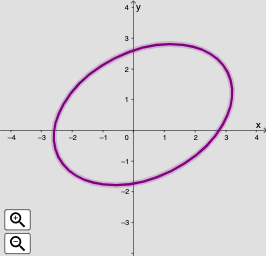
This example demonstrates the diagonalization of quadratic forms through matrix transformations, showcasing geometric feature representation. Core math concepts include matrices, eigenvalues, eigenvectors, linear transformations, and quadratic forms. GeoGebra commands and objects like If, Rotate, Transpose, Vertex, Center, Textfield, Vector, Translate, Coefficients, Line, Determinant, LaTeX, Text, Element are used, with dynamic interactions to illustrate the diagonalization process. Suitable for high school and above learners to understand the connection between linear algebra and geometry, and the invariance of quadratic forms under coordinate transformations.
GeoGebra Commands & Parameters
If(a ≟ c, pi / 4, (1 / 2 * atan(b / (a - c)))) → thetaRotate(e_1, theta) → Eigenvec1fixedRotate(e_2, theta) → Eigenvec2fixedTranspose(P) → PTVertex(g) → Vertex2, D, E, FCenter(g) → CVertex(conic) → Vertex, G, H, ICenter(conic) → BRotate(e_2, (Signo * θ)) → Eigenvec2Textfield(a) → InputBox1Textfield(b) → InputBox2Textfield(c) → InputBox3Textfield(d) → InputBox4Textfield(e) → InputBox5Textfield(f) → InputBox6If((a - c)^(2) + (2 * b^(2)) > 0, 2, If[(a - c)^(2) + (2 * b^(2)) < 0, 0, 1]) → numEigenvaluesVector(If[C ≟ C, C, Vertex2], (0, 0)) → vectorauxiliar01Translate(g, vectorauxiliar01) → g'Coefficients(g') → coefficientsVector((0, 0), If[B ≟ B, B, Vertex]) → vectorauxiliar02Rotate(e_1, (Signo * θ)) → Eigenvec1Line((0, 0), Eigenvec1) → uaxisLine((0, 0), Eigenvec2) → vaxisTranslate(uaxis, Vector[(t * vectorauxiliar02)]) → uaxis'Translate(vaxis, Vector[(t * vectorauxiliar02)]) → vaxis'Center(conic) → CentreCenter(g) → Centre2Determinant(A) → DetADeterminant(AQ) → DetAQDeterminant(P) → DetPLaTeX($5) → text1Text(text1, If[Δ_2 ≟ 0, Vertex + 0.5, B + 0.5], true, true) → text5If(sgn(theta) ≟ -1, abs(α), abs(α)) → limitthetaElement(PTAP, 1, 1) → TestEigen1Element(PTAP, 2, 2) → TestEigen2
AI Drawing Prompt Reference
Draw the diagonalization process of a quadratic form. First, input the coefficients a, b, c, d, e, f of the quadratic form. Then, calculate the eigenvectors Eigenvec1fixed and Eigenvec2fixed based on these coefficients. Rotate the original figure using these eigenvectors to demonstrate the diagonalization process. Finally, apply transformations and rotations to show the diagonal form of the quadratic in the new coordinate system, and label the centers before and after the transformation, as well as the eigenvalues.
The prompt above was compiled from the original drawing commands and is for reference only.